
All Small Six Compression

This relates to all small sixes
No particular reason, the head is off the block right now for bigger intake valves and I thought I could try to improve my quench distance.

Tighter quench means more compression and I was wondering if the combination could run safely on 91. Gas prices are only going up, so I would prefer using the 91 over the 94...
 
No particular reason, the head is off the block right now for bigger intake valves and I thought I could try to improve my quench distance.

Tighter quench means more compression and I was wondering if the combination could run safely on 91. Gas prices are only going up, so I would prefer using the 91 over the 94...
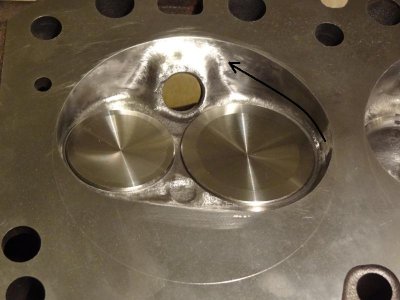
How would you improve quench distance with the cylinder head?
Thinner head gasket?

Reducing quench distance usually requires taking some off the block deck or changing pistons.
 
Yes, I have a steel shim head gasket. Milling the block is too much work for me, and I only found 1.530 compression height pistons (https://fordsix.com/threads/piston-selection-hypereutectic-vs-cast.79680/) with flat top (too much compression even with .050 head gasket) or a dish so big there would be no usabke quench area on the piston 🤷‍♂️

Also my cranking compression is between 170 and 180psi at the moment, I was planning on getting it up to ~190psi
 
Last edited:
You have some options.

Scribe the cylinder bore circle on to the head surface.
Then grind the combustion chamber walls on the spark plug side of the chamber out to the scribe line if it can be done without running into water jacket.
This should get you at least 3 to 4 cc increase in chamber volume.
Then get the flat top pistons with the 1.530" CH which should get you close to zero deck clearance.
Mill a shallow 3cc "D" dish in the top of the piston that mirrors the combustion chamber.
If you managed to get a 6 to 7cc increase in chamber volume, you can leave the piston top flat.

That should get you a 9.5 compression ratio with a .042" head gasket as the quench distance.
It also gives you max quench area.

Here is a 300 six head chamber that I did where I brought the chamber walls out to the cylinder bore scribe line.
It also helped to unshroud the 2.02" intake valve I installed.

1768671440136.jpeg
 
Last edited:
Ok your post gave me a lot to think about...
I milled the head already .027" to get to my current compression ratio. In retrospective, maybe I should've left a little bit of chamber volume for further modifications ;)

Do you think it would be possible to mill a dish into the flat top pistons that would match the cc of my current pistons, somewhere between 6.5cc to 6cc? If I would match the existing quench surfaces of the head and would only go as deep as needed into the pistons?
 
Ok your post gave me a lot to think about...
I milled the head already .027" to get to my current compression ratio. In retrospective, maybe I should've left a little bit of chamber volume for further modifications ;)

Do you think it would be possible to mill a dish into the flat top pistons that would match the cc of my current pistons, somewhere between 6.5cc to 6cc? If I would match the existing quench surfaces of the head and would only go as deep as needed into the pistons?
What is the CH of the pistons that are in the engine now?
How far down in the bore do they sit at TDC?

Do you think you can cut some out of the combustion chambers with a die grinder similar to what I did?
 
I measured my piston dishes with 6.5cc, and I measured my pistons .036" in the cylinder bores.

I can cut my chambers, but the question is how much is possible without hitting a water passage? But a few cc should be possible i guess!
 
OK
IF the cylinder head combustion chambers are 50cc (guessing)
The head gasket is .022" thick
The piston to deck clearance is .036"
The piston dish is 6.5cc
I'm assuming the engine is .030" overbore for a 3.71" bore diameter.

I'm showing a 9.272 compression ratio.

Is that correct?
 
yes engine is .030" overbored, but combustion chambers are 46.5cc (measured).

My installed Isky cam has 248 advertised duration (194 duration at .050) with 109 lobe separation, installed straight up at 0°
 
Last edited:
46.5 chamber volume
6.5 piston dish volume
.023" head gasket thickness
3.71 Bore
.036" piston to deck

Static compression 9.60
Dynamic compression 8.35

Was this the combination giving you between a 170 and 180 psi compression?
 
With a different head gasket (Mahle composite) :

46.5 chamber volume
6.5 piston dish volume
--> .045" head gasket thickness
3.71 Bore
.036" piston to deck

That combination had 170-180psi cranking compression
 
As you mentioned the steel shim head gasket will up the compression a half a point but you may be stuck having to use a higher octane, more expensive fuel.
Will that be OK?
 
As you mentioned the steel shim head gasket will up the compression a half a point but you may be stuck having to use a higher octane, more expensive fuel.
Will that be OK?
Yes higher octane would be ok.

Question now is: should I go
1) for the 1.530 pistons to tighten the quench to .042 or should I save me the trouble and
2) just put the steel shim gasket in to get to .061 quench.

If I can use 91 fuel with 1) I would do it, but if I need to use 94 fuel in both 1) and 2) then I would choose 2) because cheaper and I don't have to disassemble the block...
 
I wouldn't go through all the trouble of modifying the short block just to gain .019" of quench.
Just use the steel shim head gasket.
 
Thanks Paul for your help, I will install the steel shim head gasket and go with 94 fuel!
It's still a bump in compression and better quench then it was before ;)
 
Thanks Paul for your help, I will install the steel shim head gasket and go with 94 fuel!
It's still a bump in compression and better quench then it was before ;)
You're welcome.
If you change the compression with the head gasket and you don't like it, you will be able to go back to the thicker head gasket.
 
Back
Top