Autolite 1100 on 200 inline six

Gervill47

New member
Supporter 2020
Dear Members, I am struggling getting this carburetor adjusted and it seems that nothing I do makes it work. At this moment the car starts cold with difficulty but when it gets going and it warms up to operating temperature the chocke blade does not open and if I manually open the blade, even so slightly, the car dies. I have tried to adjust the the thermostatic spring in the lean and rich directions, but this does not seem to help in any way. The RPM when it starts is 900 rpm it does not run at the 1200 rpm when cold. Dwell is between 42 to 45.
Could someone please give me some ideas as to what to do next?
Appreciate your input. Regards, German
 
Hi, if the dwell reading is bouncing around, that is an indication of a worn distributor shaft. The 3* dwell issue is probably not causing any trouble. The problems with the carb could be a few things. If holding the choke open makes the engine die, you may have a weak fuel pump. I remove the fuel line from the carb and point it into a coffee can. While a helper turns the key, the coffee can should fill with gas I @ 20 seconds. If there is not enough fuel flow, there mey be a clog in the fuel line or gas tank. Be very carefully working with gas, and have a fire extinguisher nearby. If you have adequate fuel flow, the float may be stuck. Besides the float, the bowl of the carb may be clogged with gunk. Have you opened up the carb? The choke is heated by a choke stove pipe, which comes out of the top of the exhaust manifold. Check to see if the pipe is firmly attached at both ends. Good luck
 
Dear Members, I am struggling getting this carburetor adjusted and it seems that nothing I do makes it work. At this moment the car starts cold with difficulty but when it gets going and it warms up to operating temperature the chocke blade does not open and if I manually open the blade, even so slightly, the car dies. I have tried to adjust the the thermostatic spring in the lean and rich directions, but this does not seem to help in any way. The RPM when it starts is 900 rpm it does not run at the 1200 rpm when cold. Dwell is between 42 to 45.
Could someone please give me some ideas as to what to do next?
Appreciate your input. Regards, German
Was it running fine and then just started having this problem? Did someone do mechanical work on it like change the carb out? What year is your vehicle?
 
Thank you for the reply and interest. The car is a Mustang 1965 fast back with a 200 six in line. The car never ran smooth. I refurbished the carburetor and installed it again. The car has never had mechanical work on it. Still a stock untouched engine.
 
Dear Members, I am struggling getting this carburetor adjusted and it seems that nothing I do makes it work. At this moment the car starts cold with difficulty but when it gets going and it warms up to operating temperature the chocke blade does not open and if I manually open the blade, even so slightly, the car dies. I have tried to adjust the the thermostatic spring in the lean and rich directions, but this does not seem to help in any way. The RPM when it starts is 900 rpm it does not run at the 1200 rpm when cold. Dwell is between 42 to 45.
Could someone please give me some ideas as to what to do next?
Appreciate your input. Regards, German
If choking is required when warm, the carb is extremely lean. A check of fuel filter/fuel pressure, and check all around the intake for vacuum leaks. The PCV valve is a controlled vacuum leak. Pull the valve from the valve cover and block it off so there's no flow, engine idling, if the valve is stuck this may be cause of the lean condition.
 
Thank you for the reply and interest. The car is a Mustang 1965 fast back with a 200 six in line. The car never ran smooth. I refurbished the carburetor and installed it again. The car has never had mechanical work on it. Still a stock untouched engine.
Your 1965 fastback is a great car and not many made as far as I know and I hope you get it running good. There are many qualified forum members that will help you. My mechanical skills are limited but wanted to provide this link regarding the Loadomatic distributor and SCV carb combination which I believe was used until 1966 so if your Mustang has oem equipment you might have this. From what I have read this combination was finicky so you may want to read up on what you have. Most people will replace with a DSII ignition and non-SCV carb. Just a suggestion and you can keep the original parts and convert back to stock if needed. That is what I did with my 66 Bronco.

 
Thank you for all of your comments and suggestions. Yesterday I was able to get the fast Idle speed to run at 1200 RPM when cold. when the car got warm the chock opened and the it ran with some surging and responded to acceleration without hesitation for few minutes and then died. Unable to restart it. Fuel pressure at 4 psi, dwell at 38-41 deg. Choke open all the way.
Today I tried to start it and after some tries it did and then died and was unable to restart it. I am planning to take the carb down and replace all of the parts (accelerator diaphragm, vent valve rod, existing one is plastic, needle valve, gaskets, choke thermostat, and all else that comes with the kit., ) and bench adjust before placing it back in the engine.
Anything that can be suggested before I buy the parts and take down the unit. Could these issues be related to choke problems?
I really appreciate your comments. The current carburetor is a Chinese replica of the 1100. Carburetor has a the Load-O-matic distributor
Appreciate your comments
 
40* dwell is high, the points are staying closed longer than open. (30* dwell is 50% open/50% closed on a 6. ) This should not cause stalling unless the coil or condenser is overheating. Your symptoms do mimic coil failure, it's infrequent but does happen. Usually hard to diagnose since it's not expected. Next time you get it running and it dies, put the timing light on the coil-to-distributor wire and verify you have spark by the flashing light.

May be a fruitless test, but if spark is eliminated as cause, then dive into the carb.

Thanks for the update!
 
Thank you for the comments, I will try your suggestion. I ordered the parts anyway and taking the unit down. I will start from scratch jus to make sure that there ae no mistakes from previous disassembly.
 
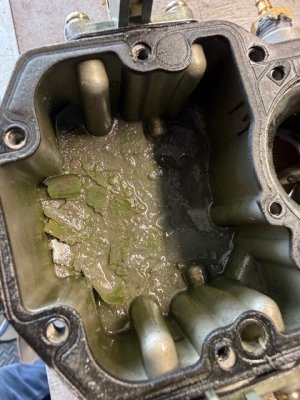
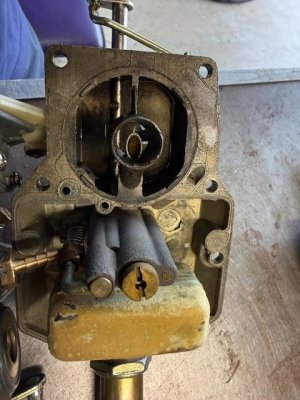
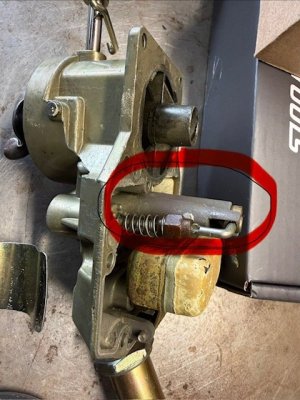
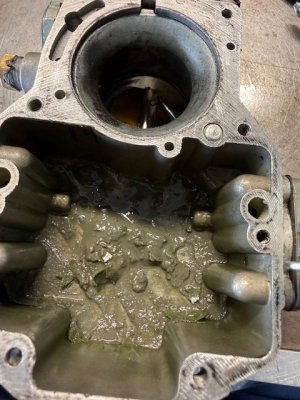
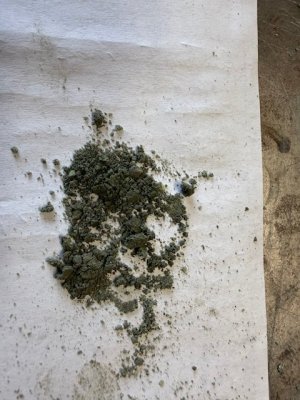
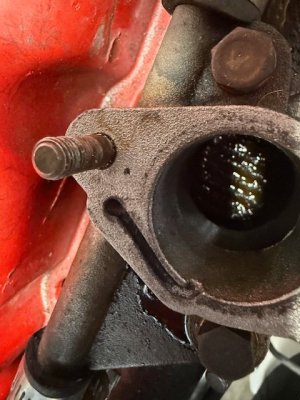
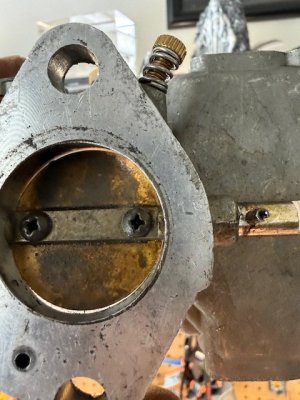
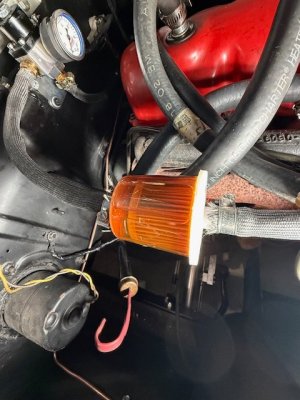
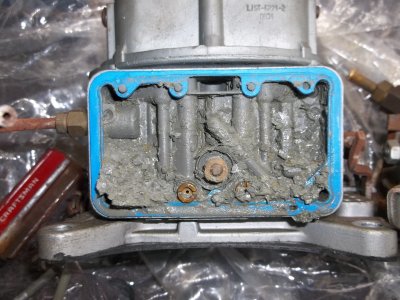
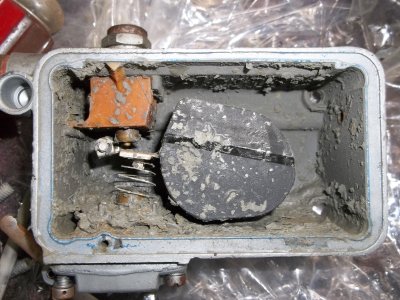
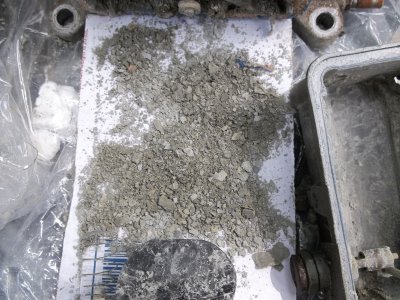
I decided to take the unit down and disassemble it. Found a bag of surprises when dissembling the unit as you can see in the enclosed pictures.
I will describe the findings by picture:

-879 Carb bowl had a slimy substance as shown. Do not know where it could be coming from. Could it be the fuel that I am using? However in two previous disassembles this slimy substance was not present.

-870 More of the same on the cover

-871 - the spring loaded shaft on the power valve does not slide up and down smoothly. It slides but it sometimes hangs

-872 & -873 - The bowl but the slime as it dried it became a fine powder. Sample of the powder as it had dried

-875 - Checked the intake manifold and the top of it showed that it was very wet with fuel

-876 - Throttle plate shows that there is a gap between the plate and the wall of the air horn of .002 in.

-877- The car has a filter and a fuel pressure regulator ay 4.5 psi, which I installed after the fuel pump failed.

Noticed as well that e accelerator pump was not squirting fuel when depressing the throttle. Also the accelerating pump weight it is stuck and I have not been able to pull it out of the carburetor bottom.
Could you give me some comments on the findings. I am waiting for the parts from Mike Carburetor.
Appreciate your replies
 

Attachments

  • IMG_0869 (1).jpeg
    IMG_0869 (1).jpeg
    80.5 KB · Views: 4
  • IMG_0870.jpeg
    IMG_0870.jpeg
    78.9 KB · Views: 4
  • IMG_0871 (2).jpeg
    IMG_0871 (2).jpeg
    79.8 KB · Views: 4
  • IMG_0872.jpeg
    IMG_0872.jpeg
    82.2 KB · Views: 4
  • IMG_0873.jpeg
    IMG_0873.jpeg
    82.9 KB · Views: 4
  • IMG_0875.jpeg
    IMG_0875.jpeg
    74.9 KB · Views: 5
  • IMG_0876.jpeg
    IMG_0876.jpeg
    73.2 KB · Views: 6
  • IMG_0877.jpeg
    IMG_0877.jpeg
    73.3 KB · Views: 6
I suspect all of that gunk was injected into your carburetor before you replaced the fuel pump and added the filter.

I can't tell for certain but it appears that the fuel in the filter is fairly clear.

Hard to say what that slime is or the powder that is its result but it sure looks like silt to my eyes. I wonder if it is junk from the gas tank or the result of hoses breaking down due to ethanol based fuels?

On the bright side, it looks like you should be able to clean that all up and you'll be back in action. I am fairly certain this gunk is the cause of your carburetor issues.
 
I agree with the above. As for the air gap in the throttle, that's normal, it's always open slightly at idle.
I had a carb with that same weird stuff in it once, the carb came off a farm work truck which was in heavy dusty conditions all the time. I concluded the dust-now-dirt entered the carb via the tank, as the vents on old vehicles are just an open line under the vehicle.
 

Attachments

  • 100_0929.JPG
    100_0929.JPG
    1.9 MB · Views: 4
  • 100_0932.JPG
    100_0932.JPG
    2.4 MB · Views: 3
  • 100_0936.JPG
    100_0936.JPG
    2.2 MB · Views: 4
Thank you for your comments. The gas tank is new and the tubing feeding the fuel pump is aluminum. Would you consider emptying the tank and replacing with fresh fuel.
Appreciate your comments and thanks for the suggestions
 
Gentlemen, I really appreciate your assistance. I would not like become a pain with some many questions, but a comment on the wetness of the top of the intake manifold would be appreciated.
Thank you
 
Gentlemen, I really appreciate your assistance. I would not like become a pain with some many questions, but a comment on the wetness of the top of the intake manifold would be appreciated.
Thank you
Malfunctioning dirty carbs can not control float level well. Any overfilling of the bowl will dribble gas into the engine and often seep outside the carb making it wet or gummy as well.
In my experience, 4 1/2 psi fuel pressure is too high for a mild street engine with any carb (except one.) After getting the carb rebuilt bring the pressure down to 3-4 psi. Reality is, the lower the pressure the easier it is on the needle/seat/float, and lower reduces hot soak flooding as well. The max pressure needed is enough to feed the carb at full power. Above that is not necessary.
 
Back
Top