All Small Six Dialing in the cold start on a Weber 38/38 with electric choke

This relates to all small sixes

awasson

Famous Member
Subscriber
To begin with, I am absolutely happy with the Weber 38/38. There is no hesitation, it gets good economy (depending on my foot) and it starts and runs great at most temps and is smooth and easy to drive with.

What my issue is, that even with the slightest choke setting, the choke blades are too far closed and don’t open quick enough for smooth starts and idle. From cold, it will start, just like that, super smooth for a few seconds and then get lopey because the choke plates are not opening quick enough. This morning’s test, after not being driven for 3 days, was giving it two shots on the gas pedal and turning the key; bam it starts right up. I jumped out of the car and pushed the choke blades open and it maintained a perfectly smooth warm up. If I had not pushed the choke blades down manually, it would have had a very lopey idle until it got warm enough to remove the electric choke.

The choke spring needs a bit of tension to engage the high idle cam which engages the throttle shaft on the high idle perch but the choke blade tension is too stiff to be pulled down by vacuum. If the choke blades were fully removed it would actually be better.

Anyone with a similar experience and any tips? I may see what it’s like if I remove the blades for testing.
 
Last edited:
It sounds like you just don’t need much choke on cold startup. I would just start adjusting the choke to the lean side, the leaner the setting the quicker it will be pulled completely off.
 
Just a guess, but that might have to do with a bigger carb on the small6. With the 32/36, you might have to use more choke.
Just a thought 🤔
 
.
I haven't worked with the 38/38 but the 32/36 on the 63' wagons' 170 starts right up with no choke hooked up. A few accel' pump squirts and it fires right up. Runs a little cold needing a few more squirts til the manifold starts warming up. Driven often in freezing temps until roads are salt covered then 'put up for the winter'.
.
. .
.
have fun
 
Is there a way to adjust the electric choke on the Weber so that it still engages the fast idle but doesn’t engage the choke blades? That would be the solution. I just can’t see an obvious way to do that without just removing the blades themselves.
 
It sounds like you just don’t need much choke on cold startup. I would just start adjusting the choke to the lean side, the leaner the setting the quicker it will be pulled completely off.

Yes, that is the problem. I can’t seem to get it adjusted to the point where the choke isn’t engaging while still engaging the high idle cam.
 
I was looking at it again this morning and it might be that there is a problem with the mechanism that engages the cold high speed idle. I had to really crank the spring tension to make it engage on the high idle cam. I’m going to look further into it when time permits. Pull it apart and see if something isn’t lined up correctly. My carb is only a year old so it’s not a wear thing. I think something is wrong with it.

Edit: It’s actually 7 years old but was sitting in a box for 5 years before I bought it from the car’s previous owner and then a good 9 months before I put it on.
 
Does it have a vacuum pull-off? American carbs have a canister hooked to manifold vacuum and linked into the choke linkage. As soon as the engine starts with the blades closed, the vacuum canister pulls the blades open, overriding the choke coil, just the right amount to hold a clean high idle.

Even with high coil closing pressure to engage high idle, the pull off is stronger and opens the blades to prevent the lopey flooding. That cold flooding is VERY hard on the rings, washes the oil off and dilutes the oil with raw gas.
 
Does it have a vacuum pull-off? American carbs have a canister hooked to manifold vacuum and linked into the choke linkage. As soon as the engine starts with the blades closed, the vacuum canister pulls the blades open, overriding the choke coil, just the right amount to hold a clean high idle.

Even with high coil closing pressure to engage high idle, the pull off is stronger and opens the blades to prevent the lopey flooding. That cold flooding is VERY hard on the rings, washes the oil off and dilutes the oil with raw gas.

It does not appear to have any mechanism to pull the blades down other than by blipping the throttle. Good advice regarding the rings and washing the cylinders down. That would be very disappointing since the engine only had a few thousand miles on it since I built it and it’s so well sorted other than the cold start issue.

I’ll be pulling the choke apart on the next day I have the chance to spend an afternoon on it. I hadn’t suspected a mechanical issue with it until today when I couldn’t get it to engage the high speed idle cam. Now I wonder if something in the choke was assembled wrong when it was put together.
 
I’ll be pulling the choke apart on the next day I have the chance to spend an afternoon on it. I hadn’t suspected a mechanical issue with it until today when I couldn’t get it to engage the high speed idle cam. Now I wonder if something in the choke was assembled wrong when it was put together.
Perhaps assembly or simply locating a point of linkage binding. On US carbs the high-idle linkage is activated by gravity. Any friction or binding, it won't set. I know nothing of the Weber, but considering its reputation I would be surprised if there were not a vacuum activated pull-off. Everyone who's mastered a manual choke knows that the instant the engine starts the choke blades have to be opened slightly, at once.

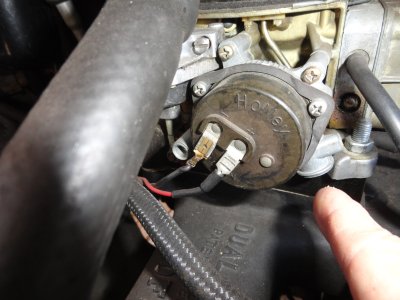
Some pull offs are incorporated into the choke coil. The old YF Carter (back to at least 1959, I have one) and most older Holley carbs have a tiny piston in a small cylinder, cast as part of the round coil housing. Linkage attaches piston to the rotating inner blade that moves the external choke blade, on the back side of the piston an internal passage to the carb base/manifold vacuum. The whole system is minute and "invisible" unless you're looking for it.

I would wager there is a pull-off assist system tucked away somewhere in your reputable carburetor.
 
Last edited:
External canister choke pull-off , late generation ('79) Ford 2150 carb. This carb is the most user friendly auto choke I've had: there is a hex head threaded adjustment screw on the rear of the canister. Perfect choke blade angle/ mixture at cold hi-idle can be dialed in by hand with that screw- and without removing the air filter. Interestingly, the vacuum source is modulated to this canister. It pulls +/- 7" from a dedicated port. The lower vacuum activates the canister more slowly, about 2 seconds after cold start it opens the blade gently. (The unused threaded fitting was the original hot-air system)

DSC06698.JPG


An internal piston-type pull-off. '84 Holley 4 barrel. It is also adjustable via the small square protrusion on the piston bore, a small Allen screw. Vacuum is routed internally to the carb base (manifold).

DSC06700.JPG
 
Last edited:
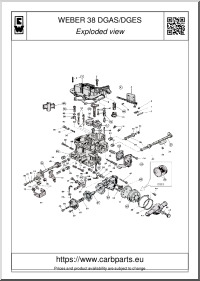
awasson, check out this exploded view. note part # 54, labeled "Choke diaphragm assembly." This may be a pull off. I can't assist any farther, except for the little Weber on dad's Pinto when I was a kid, I've never seen one. US carb, different story. 🤔

 
Last edited:
@Frank thanks for that DGES parts diagram. That's quite handy. I spotted #54 and that certainly looks like it operates the way you've described it should. Part #59 is the diaphragm adjusting screw. I'm going to have a look a that too.

I am now certain there is something wrong with the mechanism. I haven't changed anything and although the choke blades will slam shut when it's cold the way you'd expect it to, it is no longer engaging the high idle cam. It's got to be the spring on the high idle cam or the linkage that allows it to engage when the throttle is opened when the throttle is opened and it's cold.

It's all obscured by the air filter housing so I'll need to remove it and get it on my bench for a better inspection. For now, I've reduced tension on it so that it doesn't work at all and I'm just starting it with my foot maintaining the high idle. It's already an improvement and keeps it smooth and prevents it from loping.
 
Do the choke blades shut all the way with the throttle at base idle (warm engine position), or you have to open the throttles slightly, then they shut? If they're closing at base idle, there's a linkage issue for sure.

US carbs (sorry), there's no spring. The tension of the coil when cold lifts the high idle cam against gravity when some throttle is applied, as it closes the blades. Gravity releases it as the coil heats up and relaxes tension. If the high idle cam was stuck in the released position, the choke blades would not close beyond 50* or so.
 
Do the choke blades shut all the way with the throttle at base idle (warm engine position), or you have to open the throttles slightly, then they shut? If they're closing at base idle, there's a linkage issue for sure.

Yes. When the carb is cold, the blades close. When you actuate the throttle, the linkage bumps the plates slightly open and then closed again and that's when the fast idle cam usually engages.

* I have cycled this numerous times since I've owned the carb to see it do it's job BUT in the last couple of days, I have noticed that this is consistently not bumping the blades and engaging the fast idle cam. This is a behaviour that would occur once in a blue moon in recent months but wasn't consistent. Now it is just not working so there might be a screw or jam-nut on that linkage that has slipped. The blades are still always closed when it's cold though. For now, I have removed tension from the choke housing bimetal spring so that as soon as the engine starts the carb can pull them open.

US carbs (sorry), there's no spring. The tension of the coil when cold lifts the high idle cam against gravity when some throttle is applied, as it closes the blades. Gravity releases it as the coil heats up and relaxes tension. If the high idle cam was stuck in the released position, the choke blades would not close beyond 50* or so.

There is a spring on the DGES it's #38 "spring for fast idle cam" that puts tension on the fast idle cam and makes it slide into position when that linkage I mentioned above is actuated. I'll have a look at that when I get the carb on my bench as well.
 
Back
Top