
All Small Six Help! Did I just screw up my new build?

This relates to all small sixes
Willingnesslimp,
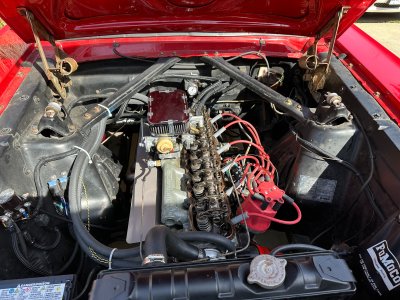
I just noticed that you are running a regulator with a pressure gauge before the carburetor. The way it looks is it’s plumbed as a dead head system (without a return line). Such a system will not work with your Weber carburetor that has a mechanical fuel pump.

My recommendation is start with a facet electric fuel pump and keep the regulator as it is.

If that doesn’t work, then I would recommend replacing the regulator with one that will allow a return to the tank.

I doubt that's the issue. The only difference he has vs mine is that his pressure gauge is in series with the carb and mine is on the gauge. I'm not crazy about the mechanical pump because it can/will heat soak and boil the modern fuel we use but aside from that, I've had no issues with mine and it's pretty close in all aspects.

I think the carb is dumping fuel.
IMG_4088 2.jpeg
 
Willingnesslimp,
I just noticed that you are running a regulator with a pressure gauge before the carburetor. The way it looks is it’s plumbed as a dead head system (without a return line). Such a system will not work with your Weber carburetor that has a mechanical fuel pump.

My recommendation is start with a facet electric fuel pump and keep the regulator as it is.

Here is a fuel pump that should work deadhead with your regulator.

If that doesn’t work, then I would recommend replacing the regulator with one that will allow a return to the tank.
I run a Holley low pressure (1-4psi) regulator w/o a return along with a mechanical pump on my Webers without issue. It’s been that way since 2008.
 
awasson and vssman,
I understand that your fuel systems are working properly. Unfortunately, this doesn’t mean that Willingnesslimp‘s setup will be functioning the same. As we all know, fuel pumps have been a crap shoot lately. I’ve seen how bad mechanical fuel pump pressure can pulsate. A single stage regulator with a return should help reduce or eliminate the issue. I’ve seen the Holley 12-882 60 psi regulator (with return) buffer out pressure impulses on a dying Holley electric in tank fuel pump. What a noisy pump!

I personally have great success with the single stage Holley Regulators with a return. They are simple, inexpensive, easy to get and they work.

Just to let others know, the Holley 12-881 regulator with return that I have can be turned down to 2 psi. I tested it because at one time I was thinking of using a Weber 32/36 on a 240. There was no fluctuations at all. And the 300 was still able to drive around with 2 psi feeding into a Holley 390 while driving around town. I didn’t push it though.

It could very well boil down to the carburetor having a piece of debris, stuck in the needle seat. Or, something else. I’m just being honest with my years of working with mechanical pumps. At one time they were reliable. Lately, I will not trust them. In other words, these days, I hate mechanical fuel pumps. A good and properly installed electric fuel pump is proven to be much more reliable and accurate on fuel delivery than most of today’s mechanical pumps. I personally will not trust any of todays aftermarket mechanical pumps on any of my vehicles.

It could be something as simple as the Weber float is out of adjustment. Unfortunately, their are times that I will take it for granted that the float level was already checked before the carburetor was installed.

What ever the issue is, it has to be something simple. Everything that has been shared today, should help with figuring out what is happening. I hope that this issue will be resolved soon.
 
Last edited:
Just for Reference:
I decided to call Holley and we had discussed issues with mechanical fuel pumps with regulators.
In light of what was discussed. The technician mentioned that electric fuel pumps are much more consistent. He mentioned that they heard of fluctuations of +/- 4 psi and at times, more with some aftermarket mechanical diaphragm fuel pumps. He mentioned that if it was his choice, it would be electric fuel pumps. The discussion ended with regulators. He mentioned, if one is able, use a regulator with a return.

I would like to close on saying that if you decide on going electric. And you’re not going with a return. Make sure that what ever electric pump you’re thinking of. Make sure that it can be dead headed.

It’s a shame that manufacturers have decided to have mechanical pumps built overseas. Maybe someday, a company will decide to start building them with better materials and better precision.
We can always hope.
 
Last edited:
I have an older fuel pump and using the regulator that Webber puts in the kits. I believe it’s a Red Line. It’s supposed to be a good one. No return line and have never had a problem in driving daily for 4 or 5 yrs. Ethanol free gas, and in Florida too. I believe I remember reading recently someone here had to return a new Webber with something wrong with it.
Maybe they are now new and improved!!🤦🤦
 
I remember. Let’s hope things get better.

Willingnesslimp,
If you haven’t already checked the float level, it might be good to check it. And look for debris in the fuel bowl, needle seat and small carb inlet filter. I would recommend doing this as soon as your able.
 
Last edited:
I remember. Let’s hope things get better.

Willingnesslimp,
If you haven’t already checked the float level, it might be good to check it. And look for debris in the fuel bowl, needle seat and small carb inlet filter.

Yes, I was thinking the same thing. Weber sent him a new replacement carb from Redline Weber but it's always a good idea to make sure the floats are set correctly. I can't help but think with the amount of fuel described in the cylinders and the smell of fuel in the oil that it must be pushing way too much fuel into the intake log.
 
Back
Top