All Small Six Help! Did I just screw up my new build?

This relates to all small sixes
Mechanical fuel pumps don't release pressure. When a hot engine is cut off they frequently build pressure, can be double-digits, because of the fuel heating up in the lines near the hot engine and nowhere to go. Can't know if there's a pressure issue without a gauge.
 
Hey! Great news @WillingnessLimp!!! That is fantastic. I was hoping it was something non-destructive.

Now, regarding the spacer... You have uncovered my suspicion about a vacuum leak. That spacer does not have gaskets glued to it. That is a piece of phenolic and it has paper bonded to each side to protect the surface while it is being machined. Plexi and Lexan has the same material. You need to add gaskets to each side. You can leave that paper on or remove it. If it's saturated with fuel and has been leaking, I'd remove it and put proper gaskets on each side.

I am so happy you've discovered the issue and it was simple.

Cheers,
Andrew
 
Mechanical fuel pumps don't release pressure. When a hot engine is cut off they frequently build pressure, can be double-digits, because of the fuel heating up in the lines near the hot engine and nowhere to go. Can't know if there's a pressure issue without a gauge.
Got it! I’m gonna add 2 fuel pressure gauges: after pump (before pressure regulator) and after pressure regulator (before carb).

Thanks @awasson! Yeah, I was under impression that those papers are acting as a gasket as well…another learning curve lol
I have 2 gaskets, that I’ll use next time, just need longer carb studs then
 
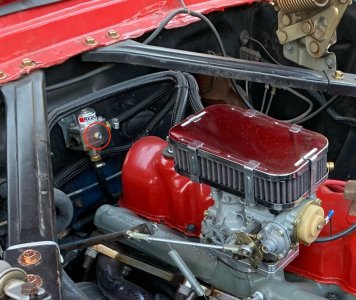
You've got the same fuel pressure regulator I have and it's mounted where mine is too. It has a 1/8" NPT fitting that faces you if you're looking at it and that is meant for a Fuel Pressure Regulator. I bought this one:


It has a rubber stopper at the back. Before you install it, remove the stopper to allow the pressure to normalize and then put it back on.
 
I see no point of the second gauge before the reg. Maybe temp just to see. It is the pressure at the carb that matters, if stays good at all times, that is all that matters. If this was EFI then we may care.
 
I see no point of the second gauge before the reg. Maybe temp just to see. It is the pressure at the carb that matters, if stays good at all times, that is all that matters. If this was EFI then we may care.
I guess I was thinking to check the inlet pressure, as Holley states to have a max inlet pressure of 7 psi.
 
You've got the same fuel pressure regulator I have and it's mounted where mine is too. It has a 1/8" NPT fitting that faces you if you're looking at it and that is meant for a Fuel Pressure Regulator. I bought this one:


It has a rubber stopper at the back. Before you install it, remove the stopper to allow the pressure to normalize and then put it back on.
Thank you! Didn’t know it has an outlet for a pressure gauge.
Honestly, I don’t remember an outlet on the face of it, but I’ll take a look tonight. You are not talking about second outlet for the fuel, right?

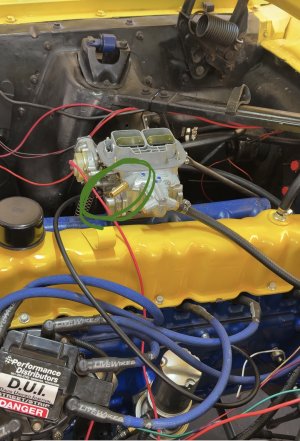
Also, does this outlet on the carb should be plugged or left as it is?
 

Attachments

  • IMG_3504.jpeg
    IMG_3504.jpeg
    536.1 KB · Views: 21
I see no point of the second gauge before the reg. Maybe temp just to see. It is the pressure at the carb that matters, if stays good at all times, that is all that matters. If this was EFI then we may care.
I kinda like the idea of knowing what the fuel pump is doing. Especially since there are so many problems with them
 
Having a thought about the rocker arm.
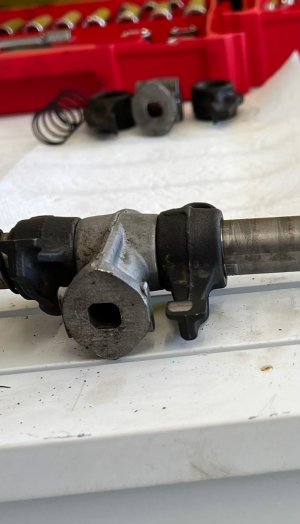
When I was cleaning/rebuilding it, I got new rocker shaft. And when I was putting it all together, the arms were sliding in nicely, but the support “towers” seems having troubles sliding in and looked like there were turning into slightly oval shape. I had hesitations about putting it all back together, but because arms were moving freely, decided to run it like this.
In this case, should I consider replacing the whole assembly? Or just get all new arms and supports?
 
That is kind of normal. If the stand/tower bolt is over torqued it can damage it, do not over torque them. No more than 35 ft lbs. and two turn for each bolt at a time till tight.
It is probably fine as long as the rockers move freely and the stands show no signs of cracks. You will have to be the Judge as we cannot tell from here.
Also if the shaft has a flat ground the length of shaft it should be down for better oiling.
 
That could be wear on the stands, maybe measure up and down then across and see the difference, then a measurement on the shaft.
Even if there is wear on them, I don’t think that is your problem
 
Thank you! Didn’t know it has an outlet for a pressure gauge.
Honestly, I don’t remember an outlet on the face of it, but I’ll take a look tonight. You are not talking about second outlet for the fuel, right?

Also, does this outlet on the carb should be plugged or left as it is?

Darn. I had a closer look at your video and you pressure regulator looks like it's different unless it's backwards to mine in the mounting bracket. Below is a photo of mine with the fitting for the gauge.

IMG_3557 2.jpeg

The outlet on the carb is an overflow. Mine has never over flowed but to be on the safe site, you could run a line to dump it somewhere away from the engine. Maybe another catch can arrangement.
 
I would try to determine if there was a physical reason it broke, I know it’s unlikely one cylinder did and not the others- but it did break. If the head isn’t pulled, I would try to flush any debris out of the push rod galley, maybe kerosene. I think I would feel better pulling the head, check the top of the piston for valve impact. Check -at least- the one valve for restricted movement. Recheck all valves for spring bind. And check anything else you can think of.
This may sound like overkill but it will give you peace of mind when you fire it again…. Well, maybe a little bit 🥹
He can buy a $25 Endoscope Camera with Light that connects to his phone and see inside the cylinder if he doesn't want to take a head off.

Endoscope Camera with Light

 
Having a thought about the rocker arm.
When I was cleaning/rebuilding it, I got new rocker shaft. And when I was putting it all together, the arms were sliding in nicely, but the support “towers” seems having troubles sliding in and looked like there were turning into slightly oval shape. I had hesitations about putting it all back together, but because arms were moving freely, decided to run it like this.
In this case, should I consider replacing the whole assembly? Or just get all new arms and supports?
Were it me, I'd change only the damaged parts. One rocker, possibly (likely) one pushrod. Changing everything re-introduces unknowns and the whole parts-mating risks that are inherent. "If it ain't broke- don't fix it."
Do verify the orientation of the shaft per post #30 above, correct oiling is the highest priority.
 
Thank you! Didn’t know it has an outlet for a pressure gauge.
Honestly, I don’t remember an outlet on the face of it, but I’ll take a look tonight. You are not talking about second outlet for the fuel, right?

Also, does this outlet on the carb should be plugged or left as it is?
The large port at the top of the bowl is a bowl vent. It doesn't do much, but what it does is important. The men who know the Weber will tell you if plugging is ok. It depends on the carb design, and I don't know the Weber.
If it needs to remain open then:
Dirt there is a no. There's no significant flow of air in/out, but it needs shielding from direct dirty under hood airflow. I put a short piece of hose on them, tucked down out of the way around the base of the carb. This simply increases the distance between the random road air passing thru and the fuel bowl access, to assure dust stays out of the bowl. With emissions systems it is routed to a charcoal canister or the like.

It should not be routed to the inside of the air filter element, it needs to read atmospheric pressure before the filter.
 
Last edited:
A couple of things to add about the shaft oiling is that the rear stand has to have a square hole on the bottom and should have the bolt that necks down after the threads. Some shafts are sent out with one of each and some all the same. Also if you have a stand with the over flow hole it should be at the front with the hole facing spark plug side, if it at rear, oil will not get to the front. Yours looks right. If the rear cam bearing is not right it can stop or hurt flow. Studs can slow flow some but not a problem if the other things are right.
Best thing is to run it with out the valve cover. If warm and at good idle oil should be flowing down each pushrod and flowing over the rocker tip at valve end. Of course oil will go every where and you will have to come up with a way to stop that.
 
A couple of things to add about the shaft oiling is that the rear stand has to have a square hole on the bottom and should have the bolt that necks down after the threads. Some shafts are sent out with one of each and some all the same. Also if you have a stand with the over flow hole it should be at the front with the hole facing spark plug side, if it at rear, oil will not get to the front. Yours looks right. If the rear cam bearing is not right it can stop or hurt flow. Studs can slow flow some but not a problem if the other things are right.
Best thing is to run it with out the valve cover. If warm and at good idle oil should be flowing down each pushrod and flowing over the rocker tip at valve end. Of course oil will go every where and you will have to come up with a way to stop that.
Thank you for the into! Just last night I was looking into support towers and trying to understand how oil gets to the shaft.
All my support towers are the same (except for the front one with overflow). The bolts - I’ll have to check, I think they were the same.
And yes, as soon as I put it all back (as per @Frank i will only change the broken arm) and I will try running it without the cover.
What if I just pump the oil with a power tool? Like when you do before first start up. Will that get the oil to the rocker shaft? Or not enough pressure and cold engine will not let it happen?
Or cranking it without spark? Like when I would check compression in the cylinders?
 

Attachments

  • IMG_2543.jpeg
    IMG_2543.jpeg
    131.6 KB · Views: 10
You could do that, and if you get satisfactory oiling to all parts go with it. It is usually hard to get oil to all parts without the engine warm and actually running.
If you do run the engine, I forgot to say that the pushrods should also be turning slowly that tells you that the lifters are turning as they must and all is good there. Edit, I know that is true on solid lifter cams and I assume that is also true of hyd. cams but maybe at higher revs, never had one.
 
Last edited:
Back
Top