All Small Six Help! Did I just screw up my new build?

This relates to all small sixes
But what if you’re rear’s don’t lock up and there is more braking power still left in them BEFORE they lock up? You will never know without being able to adjust.
If the pedal is mashed hard enough, wheels are going to slide. If all 4 slide simultaneously there is no more braking power, and no need for changing the pressure front to rear. . . or so it seems to me, but I've never had a sports car or tested the limit of my braking ability (intentionally) so I'll step back quiet now. :cool:
 
If the pedal is mashed hard enough, wheels are going to slide. If all 4 slide simultaneously there is no more braking power, and no need for changing the pressure front to rear.
True!
All I’m saying is if they don’t.
Also if you upgrade wheel cylinder in the rear like I did, one could have max braking with less pedal pressure. Which would take adjusting for max braking.
60’s vintage brake systems are pretty primitive compared to today’s systems, they can be easily upgraded but upgrades to the entire system help. Adjustable brake balance is just one factor.
I like to keep the corners square on brakes and tires👍
 
@Otto thank you for the suggestion!
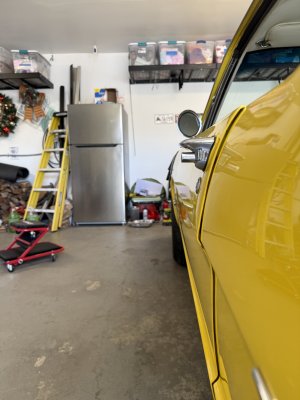
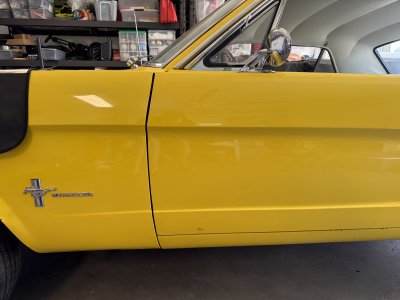
Would it be easier to remove fenders for door adjustment? I don’t think I can reach door hinge bolts with the door closed lol
I was thinking to put the door, try it, remove, adjust…and repeat. But seems like it might be a very long process, especially that I had to put new door hinges
No need to remove fenders. If Mustangs are like Falcons, the hinges bolt to the body from the inside out, so you'll have to remove the kick panel but the bolts should be easily accessed. Sometimes there will be paint marks or other clues as to where the hinges were located. Just get close to those marks as a starting point and adjust from there. If you have better marks to go by on the body, maybe try bolting hinges to the body first and then door to hinges. Or the opposite if there are better marks on the door.
Just be careful the door is not too far forward to start- so you don't catch the fender edge. If you remove the striker from the jamb, it should go pretty quickly. Just be careful to not chip anything and you should be fine.
UAW workers did this in seconds!

Edit: I just looked at the photos you posted close up and the hinges are bolted to the body from the outside; forget what I said! Falcons and Mustangs are not always the same! I have a special 1/2" wrench for hinge work like this, but it's not impossible without it.
In your case, I would bolt the hinges to the body first matching up where the old hinges attached closely (maybe slightly rearward so you don't catch the fender). Leave the bolts snug but less than fully tight so you can move them around once the door is attached and adjust from there. Once you get it perfect, fully tighten and re-install and adjust the striker.
 
Last edited:
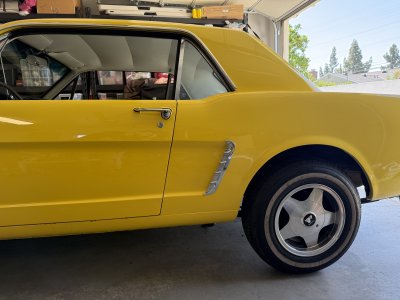
@Otto I ended up getting S-style wrenches to get to the bolts on the frame. Gosh that was pain in the ass to adjust those doors....Lined them up okay, but when I installed the striker, the door wouldn't completely go flush with the back fender (without striker it was nicely lined up). I think I need to move front part a bit outward to make the back part move in more. But I'm afraid that then I'll catch front fender. Another option I see is to elongate the holes for striker bolts, so I can push it more towards "inside" the car.
 

Attachments

  • IMG_4128.JPG
    IMG_4128.JPG
    2.1 MB · Views: 5
  • IMG_4127.JPG
    IMG_4127.JPG
    3.1 MB · Views: 4
  • IMG_4126.JPG
    IMG_4126.JPG
    3.5 MB · Views: 4
I think I went a little off topic in this thread with those doors lol

I might need some more suggestions from you guys.
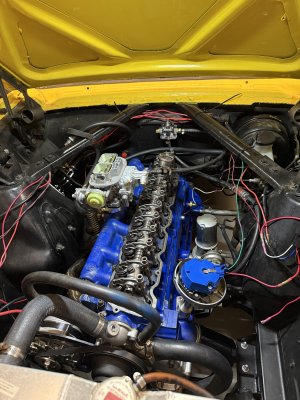
So I put everything back together in the engine (new adjustable rocker arm assembly and new replacement carb from Redline Weber). Adjusted rockers to zero lash plus 3/4 of a turn.
Carb was set up to idle screws 1.5 turns out with following jets per Redline:
Mains 145
Air corrects 170
Idle 55
E/t F50
70 double pump

Was trying to start the car yesterday and completely failed - at the beginning it was trying to start, but at the end of the day just didn't want to start. I think I ended up flooding the engine.
Decided to check the compression with new rockers. Removed all spark plugs and when I was checking compression on the first cylinder, cylinder #6 just spat up a bunch of gas from spark plug hole lol. So yeah, flooded....
Compression was good:
1st - 175
2nd - 170
3rd - 165
4th - 170
5th - 160
6th - 170
So I assume that kinda scratched possible problem with valve adjustments?

Checked the battery - was at 49% charged, so got it charged overnight.
Was trying to start it again today (after letting it air out some of the gas from the engine). It started briefly, but kept dying on me - had to hold acceleration to keep it running. Eventually it died again (when I let it go). After that, wouldn't start again.
Car ran before with faulty carb (dumping too mush fuel) and regular rocker arm.
Spark plugs are fairly fresh (maybe 40-50 miles on them).
Ignition was roughly set to 8-10 degrees advance.
Distributor gets power and I removed spark plug wire and checked that there is spark while cranking.

I'm a out of possible options what to check/do now. Not a fuel delivery problem, as it definitely gets gas in.
My options are: my DUI distributor is not giving full spark (Dyno Module?) or try to put back my non adjustable rocker arm assembly and try starting it again. Maybe I did mess up something with the valve adjustments....

Anyway, any suggestion or direction to move forward would be greatly appreciated!
 
I think I went a little off topic in this thread with those doors lol

I might need some more suggestions from you guys.
So I put everything back together in the engine (new adjustable rocker arm assembly and new replacement carb from Redline Weber). Adjusted rockers to zero lash plus 3/4 of a turn.
Carb was set up to idle screws 1.5 turns out with following jets per Redline:
Mains 145
Air corrects 170
Idle 55
E/t F50
70 double pump

Was trying to start the car yesterday and completely failed - at the beginning it was trying to start, but at the end of the day just didn't want to start. I think I ended up flooding the engine.
Decided to check the compression with new rockers. Removed all spark plugs and when I was checking compression on the first cylinder, cylinder #6 just spat up a bunch of gas from spark plug hole lol. So yeah, flooded....
Compression was good:
1st - 175
2nd - 170
3rd - 165
4th - 170
5th - 160
6th - 170
So I assume that kinda scratched possible problem with valve adjustments?

Checked the battery - was at 49% charged, so got it charged overnight.
Was trying to start it again today (after letting it air out some of the gas from the engine). It started briefly, but kept dying on me - had to hold acceleration to keep it running. Eventually it died again (when I let it go). After that, wouldn't start again.
Car ran before with faulty carb (dumping too mush fuel) and regular rocker arm.
Spark plugs are fairly fresh (maybe 40-50 miles on them).
Ignition was roughly set to 8-10 degrees advance.
Distributor gets power and I removed spark plug wire and checked that there is spark while cranking.

I'm a out of possible options what to check/do now. Not a fuel delivery problem, as it definitely gets gas in.
My options are: my DUI distributor is not giving full spark (Dyno Module?) or try to put back my non adjustable rocker arm assembly and try starting it again. Maybe I did mess up something with the valve adjustments....

Anyway, any suggestion or direction to move forward would be greatly appreciated!

In my experience, the only difference between the non adjustable rockers and the adjustable ones is that given the option to have adjustable rockers, the non-adjustable ones are a step backwards, so don’t do that.

This is a just a hunch but my suspicion is that you have over torqued the adjustments on the rocker arms. You don’t want to set lifter preload on lifters that have not been pumped up. Cold, compression appears to be good but it might be that as soon as you get some oil pressure, the lifters pump up and valves might not be sealing.

My process would be as follows:

1) I would pull the spark plugs and spin up the engine to get the fuel out of the cylinders. Dry off the plugs if they’re fuel soaked.

2) I would back my lifter preload by at least half to 3/4 of a turn.

3) See if you can get it to run.

Let it get to temperature and hopefully it runs and idles. If so, listen to the lifters. If they’re noisy, give them 1/4 of a turn. I set mine in 3 sessions until I had them at 3/4 of a turn but my lifters were never left long enough to not be pumped up and I always adjusted them when it was hot.

Keep up posted.
 
Thanks @awasson !
The only reasoning going back to non adjustable rocker - is to make sure everything else works fine and then swap them back. I did assume that I’ve made a mistake with setting up lifters.
I did set them up cold and after engine was sitting for a while (couple months probably). I saw couple YouTube videos (including Alf’s Mustang garage) and they all said to set the preload better when lifters haven’t been pumped with oil and on cold engine…

I’ll try backing them tonight. I only did 3/4 of a turn after there was zero lash, so I’ll probably start with backing out 1/2 turn
 
You have to realize that you need to spin them with your fingers VERY lightly until you just barely feel tension. It is quite easy to spin them with your fingers even after you reach 0 lash
Not moving up and down? I will definitely need to recheck them all…sometimes I wish I had someone to show me certain things and not go through trial and error
 
  • Like
Reactions: DON
Up and down works too but I used that method to double check mine. Get the set, say 1/2 turn. The back it off 3/4 and there should be play, then return it the 3/4 turn. I think the turning with fingers is a little more accurate if done correctly. You can start out holding the push rod, moving up and down to get close, the finish with the twist. Then the double check. I know it is easy to get them too tight
 
Not moving up and down? I will definitely need to recheck them all…sometimes I wish I had someone to show me certain things and not go through trial and error

It takes practice. My first hotrod had solid lifters. It sounded like a sewing machine when I got it so I decided to set them. I got about 5 blocks from home by the time everything got to temperature and the valves stopped sealing. It took me a long time to get the hang of setting those.

With hydraulics you are setting lifter preload. That's important to keep in mind. I always do my adjustments on a warm engine where the lifters are pumped. If you don't, you can't determine where zero lash is.

I do them in stages. It doesn't hurt to have them a little on the loose side so I set mine for zero lash + 1/4 turn if I'm not familiar with the engine. Then I start it, get it to idle and let it get up to operating temp. I'll listen for lifter noise and I'll listen to the exhaust for missing in case I have an adjuster too tight. Then I'll give it another 1/4 turn. I don't need to back it off or make any other adjustments because I know they're all at zero + 1/4. Then if I hear the need, I'll give it another 1/4 turn.

On mine, I ran it for several days at zero + half and then I decided to give it another 1/4. That's where I'll stay until I change the head.

Since it won't run, I'd back it off 3/4 and see if it runs. Then once you get the lifters pumped up, I'd find zero and set them properly.

Hopefully this will get you going.
 
@Otto I ended up getting S-style wrenches to get to the bolts on the frame. Gosh that was pain in the ass to adjust those doors....Lined them up okay, but when I installed the striker, the door wouldn't completely go flush with the back fender (without striker it was nicely lined up). I think I need to move front part a bit outward to make the back part move in more. But I'm afraid that then I'll catch front fender. Another option I see is to elongate the holes for striker bolts, so I can push it more towards "inside" the car.
Glad you were able to obtain the hinge wrenches, that makes it a lot easier.

Just a thought on your comment about getting the door to shut tighter- if you've brought the striker in all the way and the door is still "out", is it on the second click of the latch or the first? I have seen doors that won't fit flush to the 1/4 panel with the striker adjusted as far "in" as possible, but only catching on the first click. Adjusting the striker outward took care of it.

It's hard to tell, but the front of the door might be a bit low. Gap at the back looks good, Mustangs usually have tight lines. The door/fender alignment should be flush or the fender out slightly to avoid wind noise.
 
Glad you were able to obtain the hinge wrenches, that makes it a lot easier.

Just a thought on your comment about getting the door to shut tighter- if you've brought the striker in all the way and the door is still "out", is it on the second click of the latch or the first? I have seen doors that won't fit flush to the 1/4 panel with the striker adjusted as far "in" as possible, but only catching on the first click. Adjusting the striker outward took care of it.

It's hard to tell, but the front of the door might be a bit low. Gap at the back looks good, Mustangs usually have tight lines. The door/fender alignment should be flush or the fender out slightly to avoid wind noise.
Thank you for the tip about second click on the door lock - that actually made a huge difference and the door sits almost flush in the back now.
That door aligning situation was a one man show for me, so for now I’ll leave it as is. But you are right, it can sit higher. Just couldn’t get it up more by myself. I’ll come back to it.
 
Last edited:
It takes practice. My first hotrod had solid lifters. It sounded like a sewing machine when I got it so I decided to set them. I got about 5 blocks from home by the time everything got to temperature and the valves stopped sealing. It took me a long time to get the hang of setting those.

With hydraulics you are setting lifter preload. That's important to keep in mind. I always do my adjustments on a warm engine where the lifters are pumped. If you don't, you can't determine where zero lash is.

I do them in stages. It doesn't hurt to have them a little on the loose side so I set mine for zero lash + 1/4 turn if I'm not familiar with the engine. Then I start it, get it to idle and let it get up to operating temp. I'll listen for lifter noise and I'll listen to the exhaust for missing in case I have an adjuster too tight. Then I'll give it another 1/4 turn. I don't need to back it off or make any other adjustments because I know they're all at zero + 1/4. Then if I hear the need, I'll give it another 1/4 turn.

On mine, I ran it for several days at zero + half and then I decided to give it another 1/4. That's where I'll stay until I change the head.

Since it won't run, I'd back it off 3/4 and see if it runs. Then once you get the lifters pumped up, I'd find zero and set them properly.

Hopefully this will get you going.
Thanks Andrew! All that is helpful.
I did back off everything and reset the adjusters to just at zero lash (was very careful not to over tighten them). But then I noticed something that I overlooked before…cylinder 6 was sitting with gas in it 🤦‍♂️
So I cleared it out and tried starting again. It almost started, but didn’t stay running. Cranked some more, but nothing. Flooded it again.
Wanted to get the excess gas out of the cylinders and cranked it without spark plugs - boy it was spitting gas from cylinder #6 like crazy. I don’t understand why the gas just stays mainly there (because engine sits slanted to the back a bit?).
Anyway, while I was cranking to get the gas out, I realized that I got some in the oil (valve cover is off). So that got me thinking, that with all that flooding I was doing before And gas sitting inside cylinders - I better check the oil. Pulled the dipstick and sure enough - it smells like gas and not oil…
At this point I removed the carb and gave it couple cranks to clear out the cylinders from gas. Left everything open to hopefully help it evaporate more.
In the next couple of days I will change the oil and filter - don’t wanna damage anything beyond what I’ve already did.
Not sure if I’m having troubles with carb (maybe needle got stuck and it’s dumping fuel again) or because of all the previous attempts I just flooded it so much, that all the gas just seeped through the rings.

After the oil change, should I attempt to start it again or is there other steps I should do first?

I’m definitely getting a bit frustrated and ready to put non adjustable rockers back on and just try running the engine like this (if it’s gonna start…). And after setting the carb right (hopefully), switch to the adjustable rockers and fiddle with them

 
I think I went a little off topic in this thread with those doors lol

I might need some more suggestions from you guys.
So I put everything back together in the engine (new adjustable rocker arm assembly and new replacement carb from Redline Weber). Adjusted rockers to zero lash plus 3/4 of a turn.
Carb was set up to idle screws 1.5 turns out with following jets per Redline:
Mains 145
Air corrects 170
Idle 55
E/t F50
70 double pump

Was trying to start the car yesterday and completely failed - at the beginning it was trying to start, but at the end of the day just didn't want to start. I think I ended up flooding the engine.
Decided to check the compression with new rockers. Removed all spark plugs and when I was checking compression on the first cylinder, cylinder #6 just spat up a bunch of gas from spark plug hole lol. So yeah, flooded....
Compression was good:
1st - 175
2nd - 170
3rd - 165
4th - 170
5th - 160
6th - 170
So I assume that kinda scratched possible problem with valve adjustments?

Checked the battery - was at 49% charged, so got it charged overnight.
Was trying to start it again today (after letting it air out some of the gas from the engine). It started briefly, but kept dying on me - had to hold acceleration to keep it running. Eventually it died again (when I let it go). After that, wouldn't start again.
Car ran before with faulty carb (dumping too mush fuel) and regular rocker arm.
Spark plugs are fairly fresh (maybe 40-50 miles on them).
Ignition was roughly set to 8-10 degrees advance.
Distributor gets power and I removed spark plug wire and checked that there is spark while cranking.

I'm a out of possible options what to check/do now. Not a fuel delivery problem, as it definitely gets gas in.
My options are: my DUI distributor is not giving full spark (Dyno Module?) or try to put back my non adjustable rocker arm assembly and try starting it again. Maybe I did mess up something with the valve adjustments....

Anyway, any suggestion or direction to move forward would be greatly appreciated!
Added:
Read back some and your engine has good compression. You mentioned that the engine ran briefly. Can you roughly pinpoint how long in seconds? I understand that you know that Redline/Weber recommends 2.5 to 3 lbs. max. Just make sure you are not over 3 psi. (Preferably slightly below 3 psi. If you’re using a mechanical fuel pump that momentarily pulsates over 3 psi. I would recommend an electric fuel pump that gives a nice consistent pressure.

Below is a simple troubleshooting guide that I quickly put together. It should help you trying to figure out what could possibly be wrong so hopefully your able to pinpoint and correct the problem.


Note:
In the order written below, please follow through steps 1 through 5 in the order exactly as written. (Do not skip any steps)

1. Are the plugs are gapped properly and all have a good spark? Take note and go to step 2

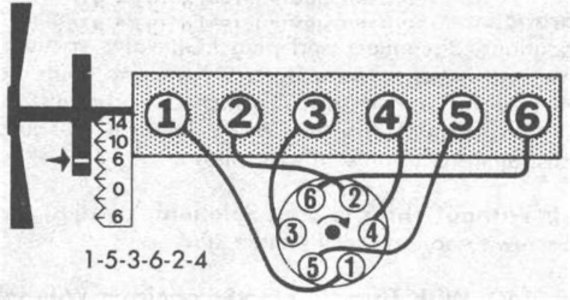
2. Is the Spark Plug firing order is correct? (See picture below) Take note and go to step 3
IMG_0504.jpeg

3. Is the distributor is 180 degrees out? Take note and go to step 4

4. Is the distributor is phased correctly? Take note and go to step 5

5. Check initial Ignition timing with a timing light. If everything is correct, the engine should fire up if it’s getting fuel.

Note:
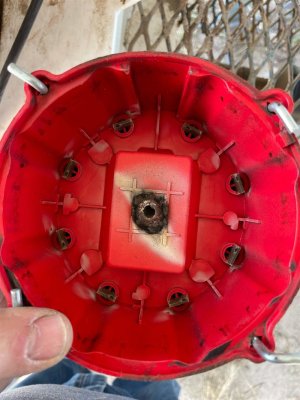
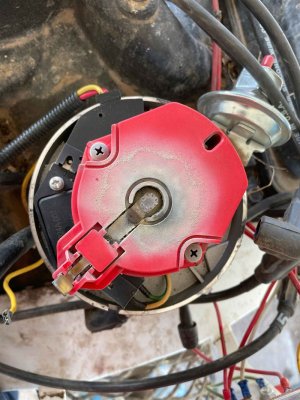
If the engine doesn’t fire up, there is a good possibility that there is something wrong with the DUI distributor. Check the coil, module, magnetic pickup, distributor shaft for excessive side play and reluctor air gap. Then proceed to the next sentence below.

I’m not a 100% sure, I think some HEI caps use carbon tracing to make contact from ignition coil to rotor. I think some rotors also use carbon tracing to the rotor end. Please check them out.

The pictures below are extreme examples:
IMG_0407.jpeg


IMG_0408.jpeg

Added:
If your spark plug cables are carbon core, it would be a good idea to consider switching to wire wound spark plug cables. High resistance spark plug cables can cause caps and rotors to burn out quicker.
 
Last edited:
Hey @63 Sprint , thank you for the guidelines - I'll check it all after I get to change the oil - don't want to crank the engine anymore with gas in oil.

I do want to say, that the car was running with current parts (spark plugs, dizzy). The only thing that was changed/updated - adjustable rocker arm and replacement carb (Weber 38/38).
I did have a problem before, that I put dizzy 180 off - but it was backfiring in the intake. With my recent attempts to start - it started couple times, but didn't stay running.

The dizzy looks good, nothing looks burnt or anything similar. I have LiveWires coming from it. Spark plug gap is set to .050"

I do wanna ask you about checking the spark - I assume I should check all cylinders? I did check #1 cyl by pulling the wire off the plug and cranking with ignition on - had a spark there. Should I check the spark with actual spark plug connected to the wire - to make sure that spark plugs are okay?

And then I do have a spare Dyna Module, that I can swap and see if that changes anything.
 

Attachments

  • IMG_4140.JPG
    IMG_4140.JPG
    3.3 MB · Views: 1
Back
Top