All Small Six Help! Did I just screw up my new build?

This relates to all small sixes
Willingnesslimp,
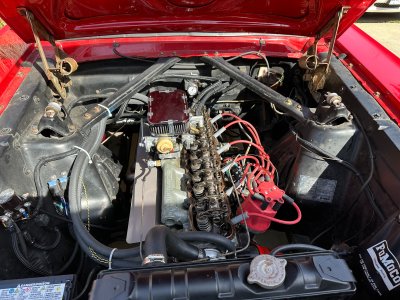
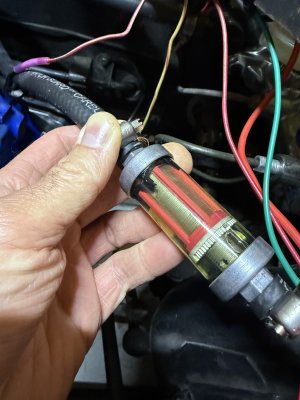
I just noticed that you are running a regulator with a pressure gauge before the carburetor. The way it looks is it’s plumbed as a dead head system (without a return line). Such a system will not work with your Weber carburetor that has a mechanical fuel pump.

My recommendation is start with a facet electric fuel pump and keep the regulator as it is.

If that doesn’t work, then I would recommend replacing the regulator with one that will allow a return to the tank.

I doubt that's the issue. The only difference he has vs mine is that his pressure gauge is in series with the carb and mine is on the gauge. I'm not crazy about the mechanical pump because it can/will heat soak and boil the modern fuel we use but aside from that, I've had no issues with mine and it's pretty close in all aspects.

I think the carb is dumping fuel.

IMG_4088 2.jpeg
 
Willingnesslimp,
I just noticed that you are running a regulator with a pressure gauge before the carburetor. The way it looks is it’s plumbed as a dead head system (without a return line). Such a system will not work with your Weber carburetor that has a mechanical fuel pump.

My recommendation is start with a facet electric fuel pump and keep the regulator as it is.

Here is a fuel pump that should work deadhead with your regulator.

If that doesn’t work, then I would recommend replacing the regulator with one that will allow a return to the tank.
I run a Holley low pressure (1-4psi) regulator w/o a return along with a mechanical pump on my Webers without issue. It’s been that way since 2008.
 
awasson and vssman,
I understand that your fuel systems are working properly. Unfortunately, this doesn’t mean that Willingnesslimp‘s setup will be functioning the same. As we all know, fuel pumps have been a crap shoot lately. I’ve seen how bad mechanical fuel pump pressure can pulsate. A single stage regulator with a return should help reduce or eliminate the issue. I’ve seen the Holley 12-882 60 psi regulator (with return) buffer out pressure impulses on a dying Holley electric in tank fuel pump. What a noisy pump!

I personally have great success with the single stage Holley Regulators with a return. They are simple, inexpensive, easy to get and they work.

Just to let others know, the Holley 12-881 regulator with return that I have can be turned down to 2 psi. I tested it because at one time I was thinking of using a Weber 32/36 on a 240. There was no fluctuations at all. And the 300 was still able to drive around with 2 psi feeding into a Holley 390 while driving around town. I didn’t push it though.

It could very well boil down to the carburetor having a piece of debris, stuck in the needle seat. Or, something else. I’m just being honest with my years of working with mechanical pumps. At one time they were reliable. Lately, I will not trust them. In other words, these days, I hate mechanical fuel pumps. A good and properly installed electric fuel pump is proven to be much more reliable and accurate on fuel delivery than most of today’s mechanical pumps. I personally will not trust any of todays aftermarket mechanical pumps on any of my vehicles.

It could be something as simple as the Weber float is out of adjustment. Unfortunately, their are times that I will take it for granted that the float level was already checked before the carburetor was installed.

What ever the issue is, it has to be something simple. Everything that has been shared today, should help with figuring out what is happening. I hope that this issue will be resolved soon.
 
Just for Reference:
I decided to call Holley and we had discussed issues with mechanical fuel pumps with regulators.
In light of what was discussed. The technician mentioned that electric fuel pumps are much more consistent. He mentioned that they heard of fluctuations of +/- 4 psi and at times, more with some aftermarket mechanical diaphragm fuel pumps. He mentioned that if it was his choice, it would be electric fuel pumps. The discussion ended with regulators. He mentioned, if one is able, use a regulator with a return.

I would like to close on saying that if you decide on going electric. And you’re not going with a return. Make sure that what ever electric pump you’re thinking of. Make sure that it can be dead headed.

It’s a shame that manufacturers have decided to have mechanical pumps built overseas. Maybe someday, a company will decide to start building them with better materials and better precision.
We can always hope.
 
I have an older fuel pump and using the regulator that Webber puts in the kits. I believe it’s a Red Line. It’s supposed to be a good one. No return line and have never had a problem in driving daily for 4 or 5 yrs. Ethanol free gas, and in Florida too. I believe I remember reading recently someone here had to return a new Webber with something wrong with it.
Maybe they are now new and improved!!🤦🤦
 
I remember. Let’s hope things get better.

Willingnesslimp,
If you haven’t already checked the float level, it might be good to check it. And look for debris in the fuel bowl, needle seat and small carb inlet filter.

Yes, I was thinking the same thing. Weber sent him a new replacement carb from Redline Weber but it's always a good idea to make sure the floats are set correctly. I can't help but think with the amount of fuel described in the cylinders and the smell of fuel in the oil that it must be pushing way too much fuel into the intake log.
 
You just proved a point! 18 years ago we did not have this problem.:unsure:
Mine is a Redline/Weber billet regulator. It looks like a Holley but has a redline sticker on it. It's a couple of years old.

The fuel pump looks new.

Before I got my hands on it, it was an estate sale and it looks like some of it was hastily reassembled. I've had everything apart except for the rear end diff (that's next). I figure the fuel pump on mine is from around 2019/2020 when the PO bought it from the estate.
 
@sixtseventwo4d thank you for precaution! Honestly, didn't even think about all the possible vapors

@63 Sprint I totally understand what you are saying about mechanical fuel pump and pulsating fuel pressure. It did make me think about putting in an electric one. Not set on that yet. The link you shared is for pump with 2-4.5psi. Would it make sense to go with this ONE or pretty much it's the same thing.
But, the engine ran before (not great, but it did) with fuel pressure before the carb showing about 3 psi. Now I can try I reduce the pressure on the regulator (should be set to about 2.7-2.9 psi stock) and see if that helps.
I did notice that in recent attempts to start the car, when fuel would come to the carb, initial pressure with go up to 4-4.5 psi and then drop to about 3 psi.

I was gonna mention @awasson, as he does have the same set up, but he already chimed in :)
On the other. hand, I did have problem with fuel dumping before the carb was replaced - but throttle blades wouldn't close completely and progression ports were always exposed, even at idle. And yes @DON I did get a new carb from Redline (which is putting out too much fuel again).
So maybe my problem this time is not the carb itself, but the fuel delivery.

@63 Sprint @awasson I have taken the carb off the car and will check the float level and for any debris in there. I did put new inline fuel filter before pressure regulator this time and it seems clean so far. I will not attempt any new start ups until at least I change fouled oil and filter. And might try to start it again with my old non adjustable rockers (just to exclude this possible problem with adjusters).

Now that I'm thinking back to when I was trying to start it and it was flooding yesterday, I can clearly hear liquid coming down somewhere inside to the oil pan. Didn't pay much attention to that at the moment, as I was thinking it's just oil dropping back to the pan. But I have a feeling that was gas leaking down the cylinders. And again, why is it only cylinder #6 was full of gas and all others were just wet?

 
Last edited:
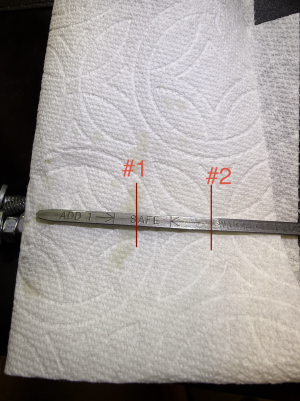
Just went back to the car to check oil level - was curious if it changed with the gas in it..... Well, to my surprise it changed drastically. See attached picture - #1 is the original oil level (checked before I did all those attempts to start the car), #2 is where it is now. Hard to see on the picture that mark, but in person you can see it. And the color is very pale, not oil color.

Also noticed that the inline filter has some rubbery debris from somewhere - maybe it's just part of the internals of the filter. But I didn't see them at the beginning of last 2 days attempting to start the car.
 

Attachments

  • IMG_4149.JPG
    IMG_4149.JPG
    1.2 MB · Views: 1
  • tempImageq7bTgk.png
    tempImageq7bTgk.png
    5.3 MB · Views: 1
Ok, carburetor is dumping lots of fuel in the intake manifold. As you mentioned earlier, no longer run the engine until the he oil is changed and the carburetor is fixed.

It seems like those electric pumps have very low draw lift compared to the Facet Cube Pumps. I can’t give you an answer if they are any good.
I’ve seen Facet pumps run for years on industrial applications and never seen one go bad. Plus they are made in the U.S.
 
Last edited:
Back
Top