All Small Six Help! Did I just screw up my new build?

This relates to all small sixes
Another update:
Fired up the car tonight. Fuel pressure is good - steady 2.5 psi now.
Engine wouldn’t stay running unless I open up the throttle like half way. And it was running very rough and I think it was misfiring badly. Timing was set to TDC, but I moved it a bit to about 8-10 degrees.
I haven’t checked the spark on spark plugs yet, @sixtseventwo4d got me a bit scared with under hood fumes and I chickened out lol (had a fire in the garage 5 years ago, so having ptsd after that 🤦‍♂️).
Eventually engine died and I didn’t want to crank more - didn’t want to flood it again.
Removed spark plugs and checked cylinders - #6 had some gas again, so I cranked without ignition and fuel line disconnected to get everything out. I think because it sits slanted towards the back it just drains there.
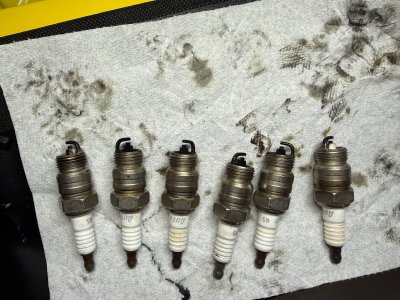
Spark plugs got all dark (left to right from #1).

Planning on coming back to check the spark tomorrow, after everything is aired out.
I’m concerned about cyl 6, as the wire clamp to spark plug became undone once - I fixed it, but maybe it became undone again.

I do think now it’s the time to check everything with the dizzy.

Should I try new spark plugs as well?
I have autolite ap45 now
Glad to hear it. I’m assuming you’re now using an electric fuel pump?

I don’t understand why you have to crank the carb open like that to keep it going. My Weber 38/38 would be at redline if I held the carb half open out of gear. Clogged jets will cause that kind of trouble but your carb just arrived and I think you’ve gone through it to ensure it’s in good shape.

Your plugs should be tan or light tan.

Do you have the vacuum advance on the carb blocked off? If you’re not using vacuum advance put your initial timing at about 20 degrees; you can adjust it and really dial it in later. These engines want a ton of timing at idle. Mine is at 22 degrees at idle with initial of 12 degrees plus vacuum advance of 10 degrees from manifold vacuum.

You think it’s misfiring? Popping through the carb or the exhaust? Were you lifters making any clacking noise?

You might still be too tight on the lifter preload. If the valves aren’t closing you would absolutely have to have the carb pinned open to keep it idling and it would eventually die and not want to start until it cooled and the metal contracted again.
 
WillingnessLimp,

Please be as detailed as you can on any changes that were done, and document all changes.


Question:
Are you still using a mechanical fuel pump?


Please verify:
Engine timing


Simple test:
Here is a test that I would like you to do.
Pull the plugs and air out the cylinders and intake manifold. Then work on getting the engine running again. As soon as the engine starts running, take a pair of vise-grips or C-clamp and block (pinch) off the rubber fuel line at the carburetor. What you will be doing is stopping the carburetors fuel supply. Now listen to the engine. The engine will quickly run out of fuel and a severely rich fueled engine should start going lean and start operating smoother before it stalls out. If this happens, the fault is the carburetor or the fuel supply. (It could possibly be both)
 
Last edited:
@awasson @63 Sprint
Here is some additional info:
- still running mechanical fuel pump
- I've changed fine filter location to after the fuel pressure regulator and right before the carb
- fuel pressure shows steady 2.5 psi, no more jumping up to 4-4.5psi at cranking. After the car dies, fuel pressure was holding steady at 2.5 psi for some time
- maybe I went overboard about 1/2 throttle open to keep the engine running, but definitely around 1/3 of the throttle or above. Stays at high rpms, but not red zone (can't see my tach from that location - but will try to move tach around tonight, so I can see it while holding the throttle)
- timing it set approximate: dropping dizzy at TDC, then moving crank to 10 degrees advance (against normal engine rotation) and setting dizzy to #1 cylinder. I can't really connect timing light yet - I have to hold throttle open to keep the engine running. Of course I can adjust the idle speed screw to keep throttle at that level, but I feel like I'm gonna do more damage to the engine if I keep it running at higher rpm without any warm up
- I put back my non adjustable rocker arm - for now just wanted to exclude possibility of hang open valves and solve running issue
- took plugs out last night and cranked the engine to remove any leftover gas (fuel line disconnected)
Edit: @awasson yes, I’m running the carb with vacuum plugged and nothing is connected to dizzy

@awasson honestly, didn't focus on any clanking noise from lifters, was just trying to keep the engine running. But also engine was running at higher rpms, so its loud and I might have totally missed any irregular sounds.

@63 Sprint thank for the test suggestion - I will try it tonight. I will also pick up fresh spark plugs and will go with regular copper ones (Autolite 45).

Something that I noticed last night as well (not sure if that matters). As I posted pics of my cylinders in Post #42 and Post #43 you can see a lot of carbon build up after short time (maybe 20-30 miles driving on the new rebuild). Now that I'm looking down my cylinders, I see a lot of that build up is gone. My assumption is that all that extra fuel from flooding and sitting in the cylinders got it loose and it started to burn off. Maybe that's why my plugs are so black now? Also, could those particles have possibly damaged or preventing valves from properly closing?

I will try to take a video tonight of starting the engine.
 
Last edited:
- I put back my non adjustable rocker arm - for now just wanted to exclude possibility of hang open valves and solve running issue

With everything else going on, that's a good idea. You can always swap them back when you get this sorted out.

Something that I noticed last night as well (not sure if that matters). As I posted pics of my cylinders in Post #42 and Post #43 you can see a lot of carbon build up after short time (maybe 20-30 miles driving on the new rebuild). Now that I'm looking down my cylinders, I see a lot of that build up is gone. My assumption is that all that extra fuel from flooding and sitting in the cylinders got it loose and it started to burn off. Maybe that's why my plugs are so black now? Also, could those particles have possibly damaged or preventing valves from properly closing?

I doubt that's the cause of the dark plugs but yes, gasoline is a wonderful solvent and probably cleaned those piton tops, valves and combustion chambers right off. I'm not concerned that the debris would cause any trouble with the valves closing though.

- timing it set approximate: dropping dizzy at TDC, then moving crank to 10 degrees advance (against normal engine rotation) and setting dizzy to #1 cylinder. I can't really connect timing light yet - I have to hold throttle open to keep the engine running. Of course I can adjust the idle speed screw to keep throttle at that level, but I feel like I'm gonna do more damage to the engine if I keep it running at higher rpm without any warm up

It could be that your timing is grossly advanced or retarded if you dropped it a tooth ahead or behind. You ought to get a timing light on it so you can figure out where you are at.

I've put some tape on my distributor shaft and the block with markings so I know where 10 degrees initial and 14 degrees initial are. I know my vacuum advance adds 10 degrees and I've confirmed it with my Sears timing light. That way I can very quickly set my timing to 10, 12 and 14 degrees which makes 10, 22, 24 degrees at idle because I'm using manifold vacuum.

Do you have your manifold vacuum plugged and the PCV opening on the valve cover open? You might as well leave the PCV out of the equation and have all sources of vacuum leaks plugged until you have it running correctly.

My suggestion would be:
  • Find out what your timing is. It should idle without dying at +10° but it'll be happier idling at +20° - +24°.
  • Base carb settings: idle/air screws turned out from zero 1.5 turns each, with 55 idle jets and the idle screw around half a turn in.
  • ensure there are no vacuum leaks so remove the PCV and vacuum advance. Plug the vacuum advance port on the carb.
 
It could be that your timing is grossly advanced or retarded if you dropped it a tooth ahead or behind. You ought to get a timing light on it so you can figure out where you are at.
Andrew, everything makes sense and tonight I’m planning to double check the float level (googled about float level issues/flooding and a lot of issues come up similar to what I’m experiencing)

This thing about one tooth off is the only thing I cannot agree on. And please correct me if I’m wrong (I actually recently was looking up about this).
So I’m dropping distributor with first piston at TDC and noting where the rotor is pointing. Then I’m rotating my distributor and lining up the mark for the first cylinder on it to the rotor. That’s pretty much zero advance. Because on DUI distributor you can rotate the body 360 degrees and the cap can only be put one way, you can always get to that number one cylinder, where the rotor is pointing by rotating the body. And then from there rotate distributor body counterclockwise to give it advance. So technically, that “tooth off” is just for where you want your #1 cyl to be - so all my wires can reach the cylinders.

 
Last edited:
Here is the latest:
- put all new spark plugs (Autolite 45)
- checked the float level again - all good (18mm and 24mm)
- adjusted spark plug wire #6 - the sleeve was a bit long and suspect to not fully latching into the spark plug
- checked spark for all cylinders - all good there
- fuel pressure was a bit below 2.5 psi

I'm going to add a link to videos with start up - I apologize in advance for 5 min video. Engine starts at about 1 min mark.
The car started, but agin didn't want to stay running - I was holding the throttle. Somewhere in the middle of the video you can see the engine was running at more or less constant rpms - I was able to take a peak at the tach and it was at 1,000 rpm. But the throttle was still about 1/3 open - to keep it running.
As @awasson mentioned, maybe the timing is off a lot. You can see me trying to manipulate dizzy and when I back it up (counterclockwise) the engine at least smoothed out a bit (but still only running while I hold the throttle open).
@63 Sprint I was not able to perform your suggested test...completely forgot to put locking pliers next to me. Same for the timing light - wasn't next to me.
For second video I grabbed everything next to me, but it wouldn't start. Didn't crank further as I didn't want to flood the engine again.

Also adding a picture of new spark plugs after that run. I guess it's hard to judge them because engine is not running properly.

Video of the first start

Second attempt
 

Attachments

  • IMG_4176.jpg
    IMG_4176.jpg
    4.4 MB · Views: 5
On the first start video, it' running pretty well from 1:50 and on, all things considered. At 3:44, it seems to be running its best when it's got to be close to 800 - 900 RPM. Then at 3:50, you've got it close to 500 - 600 RPM and it's stumbling a bit. It's a cold engine, that's normal.

1) Keep in mind that it's cast iron and it's not going to be at proper temperature for 5 or 10 minutes and until that point it's just not going to idle well. I would attempt to get the idle around that sweet spot of 800 - 900 and then get it up to temperature. You'll know you're getting there when the thermostat opens and the temperature gauge starts to swing. Then you can adjust the idle/air mixture.

2) I know the Weber best lean idle instructions say to only screw the idle speed screw 1/2 a turn because they don't want you adjusting the idle mixture when it's off the idle circuit but you can tell when it's off idle by checking the ported vacuum port on the front of the carb. If it's not drawing vacuum, you are still on the idle circuit. Mine doesn't come off idle until at least one turn in so don't be afraid of turning the idle screw in to get it to a decent idle speed. You want it somewhere around 800 - 900 until you can get the tune and timing sorted out.

3) You really need a timing light to figure out your timing. These engines want a ton of initial/idle timing.

3b) In terms of vacuum advance, I found after about a year of trying to get ported vacuum advance right, that manifold vacuum was the way to go. I set initial to 12 degrees and my HEI gives me 10 degrees on the vacuum canister. Your DUI might give you more so a timing light would be handy. Mine really likes +22 degrees of advanced timing at idle.

4) It also looks like the PCV is hooked up and so is the power brake booster. Make sure there are no vacuum leaks on those.

5) Those plugs might be deceiving you and could be discoloured from the many attempts earlier when it was flooding. The might clean up with a proper drive at speed and at proper temperature.

Overall, I'm encouraged. When it's running nicely at 3:44 in the video, for a cold engine from what I can see, it's running smoothly. It needs to be run for 5 or 10 minutes to warm up though and you need your timing sorted out.
 
On the first start video, it' running pretty well from 1:50 and on, all things considered. At 3:44, it seems to be running its best when it's got to be close to 800 - 900 RPM. Then at 3:50, you've got it close to 500 - 600 RPM and it's stumbling a bit. It's a cold engine, that's normal.

1) Keep in mind that it's cast iron and it's not going to be at proper temperature for 5 or 10 minutes and until that point it's just not going to idle well. I would attempt to get the idle around that sweet spot of 800 - 900 and then get it up to temperature. You'll know you're getting there when the thermostat opens and the temperature gauge starts to swing. Then you can adjust the idle/air mixture.

2) I know the Weber best lean idle instructions say to only screw the idle speed screw 1/2 a turn because they don't want you adjusting the idle mixture when it's off the idle circuit but you can tell when it's off idle by checking the ported vacuum port on the front of the carb. If it's not drawing vacuum, you are still on the idle circuit. Mine doesn't come off idle until at least one turn in so don't be afraid of turning the idle screw in to get it to a decent idle speed. You want it somewhere around 800 - 900 until you can get the tune and timing sorted out.

3) You really need a timing light to figure out your timing. These engines want a ton of initial/idle timing.

3b) In terms of vacuum advance, I found after about a year of trying to get ported vacuum advance right, that manifold vacuum was the way to go. I set initial to 12 degrees and my HEI gives me 10 degrees on the vacuum canister. Your DUI might give you more so a timing light would be handy. Mine really likes +22 degrees of advanced timing at idle.

4) It also looks like the PCV is hooked up and so is the power brake booster. Make sure there are no vacuum leaks on those.

5) Those plugs might be deceiving you and could be discoloured from the many attempts earlier when it was flooding. The might clean up with a proper drive at speed and at proper temperature.

Overall, I'm encouraged. When it's running nicely at 3:44 in the video, for a cold engine from what I can see, it's running smoothly. It needs to be run for 5 or 10 minutes to warm up though and you need your timing sorted out.
Andrew, thank you for the feedback! I am getting a little more encouraged that at least it’s starting and running somewhat lol

1) and 2) I was thinking this morning on my drive to work, that I might have a problem with the idle circuit. Engine is pretty much stays running only when I open up main jets.
I haven’t checked that on my carb. I did remove idle jets and made sure nothing is stuck in them, but I haven’t removed the idle screws. Want to try that tonight and blow it with some air in case something is stuck there. I’ve never dealt with carbs and to my assumption, I can remove the jets and idle screws and blow some air in the holes to clear it out. Would that be correct way? Or do I need more disassembly?

3) yes, I want to time it and I have the light. I just can’t do it when I have to hold the throttle open with one hand. And as for speed screw to hold it running - it needs to be screwed in pretty far. I was gonna attempt it last night on the video, but realized how far it needs to go it.

4) that’s another thing I will try to exclude from the occasion now - I’ve ordered vacuum plugs and will disconnect it at the next try. After I can make engine idle at least, I’ll check all the base gaskets and manifold ports with spraying carb cleaner.

5) I agree on that, not enough running time to judge by that. At least they are not fouled with gas anymore ◡̈
 
Andrew, thank you for the feedback! I am getting a little more encouraged that at least it’s starting and running somewhat lol

1) and 2) I was thinking this morning on my drive to work, that I might have a problem with the idle circuit. Engine is pretty much stays running only when I open up main jets.
I haven’t checked that on my carb. I did remove idle jets and made sure nothing is stuck in them, but I haven’t removed the idle screws. Want to try that tonight and blow it with some air in case something is stuck there. I’ve never dealt with carbs and to my assumption, I can remove the jets and idle screws and blow some air in the holes to clear it out. Would that be correct way? Or do I need more disassembly?

3) yes, I want to time it and I have the light. I just can’t do it when I have to hold the throttle open with one hand. And as for speed screw to hold it running - it needs to be screwed in pretty far. I was gonna attempt it last night on the video, but realized how far it needs to go it.

4) that’s another thing I will try to exclude from the occasion now - I’ve ordered vacuum plugs and will disconnect it at the next try. After I can make engine idle at least, I’ll check all the base gaskets and manifold ports with spraying carb cleaner.

5) I agree on that, not enough running time to judge by that. At least they are not fouled with gas anymore ◡̈
(At the risk of not remembering earlier posts)- what camshaft is in it? And has it been removed/installed and timing verified since it was last running ok?
Reason- engine sounds chunky. Could be lean, ignition timing, vacuum leak, OR late valve timing.
In your start up attempts has it backfired in the carb at all?

PS, carefully placed vice-grip plyers hold throttle open position well.
 
@Frank As I recall, he's running a Clay Smith Cam with 302 springs. I don't recall the camshaft profile. It's a street performance cam, probably a H-264-0-B which seems to be the popular choice for a little bump in performance without being unruly to tune.

My experience with a similar setup (Clay Smith H-6474-0-B) is that they aren't happy idling until warmed up. My fast idle is at a little past 1500 RPM and I let i warm up for several minutes until it's quite warm and then my regular idle is a bit choppy at 500 - 600 RPM until it's warmed right up. Then it'll idle all day at 800 - 900 RPM (unless I get stuck in traffic and the mechanical fuel pump boils the gas).
 
(At the risk of not remembering earlier posts)- what camshaft is in it? And has it been removed/installed and timing verified since it was last running ok?
Reason- engine sounds chunky. Could be lean, ignition timing, vacuum leak, OR late valve timing.
In your start up attempts has it backfired in the carb at all?

PS, carefully placed vice-grip plyers hold throttle open position well.
Frank, I’m running Clay Smith H-267-8-B. I did degree the cam when installed (if that’s what you mean). Since then I haven’t pulled the engine out or did anything with internals. Ignition timing is not confirmed yet - don’t have an extra hand, but will try to attempt it again.

No backfires into carb, since last time I’ve installed dizzy incorrectly lol

I’ve stumbled upon this POST and if I can’t figure out situation with the idle circuit or vacuum leak, getting a different PCV valve might be my next bet. I think @DON actually suggested that Me Wagner PCV
 

That has a lobe center of 108 on the intake and exhasts which will produce a choppier idle and a little lower vacuum than one with a 110 lobe center. To me that means that being properly warmed up is even more critical. On the upside, compared to a 267 camshaft with a 110 lobe center, you get increased torque and faster throttle response than a 267 camshaft with a 110 lobe center so it's a win once you get it sorted out.
 
Back
Top