200ci PCV and vacuum advance off same manifold port?

This applies only to 200ci

rrbc

New member
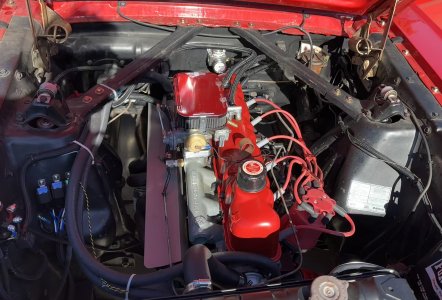
Can I run PCV and vacuum advance off same manifold port? Not sure if this is an option. Right now I have a breather cap on oil fill, pcv valve on rear of VC with a hose running to the air filter on my center carb. Running three weber 34's so no vacuum port on carbs, and no room to run a spacer.

Option A: Run as is
Option B: Tee at manifold port to run pcv and vacuum advance
Option C: Run breather caps on both ends of VC

Sorry for the newb questions but this car was gifted to us and trying to figure out best practices! Thanks in advance.
 
Can I run PCV and vacuum advance off same manifold port? Not sure if this is an option. Right now I have a breather cap on oil fill, pcv valve on rear of VC with a hose running to the air filter on my center carb. Running three weber 34's so no vacuum port on carbs, and no room to run a spacer.

Option A: Run as is
Option B: Tee at manifold port to run pcv and vacuum advance
Option C: Run breather caps on both ends of VC

Sorry for the newb questions but this car was gifted to us and trying to figure out best practices! Thanks in advance.
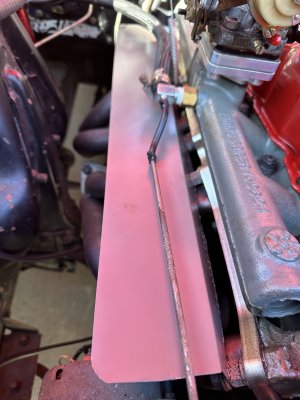
Yes. I’m running manifold vacuum to my HEI distributor and my PCV valve goes to a sealed catch can and the catch can goes to the same fitting. It has a barb for each sized hose.


IMG_3999.jpeg


IMG_3992.jpeg
 
Hey… I just reread that. Tri-power, huh? Nice! I have been considering a tri-power for my new head build.

There are members here with tri-power setups and experience with them. After you’ve posted 5 times you’ll be able to post photos of your setup and I’m sure you’ll get any advice you need.
 
Hey… I just reread that. Tri-power, huh? Nice! I have been considering a tri-power for my new head build.

There are members here with tri-power setups and experience with them. After you’ve posted 5 times you’ll be able to post photos of your setup and I’m sure you’ll get any advice you need.
Yeah…. And admittedly I’ve never been a guy who works on cars haha. My wife had this car in high school, sold it to her father and he spent the last 25 years building it out. He recently gifted it back to her (made good on his promise l) and now….. I’m learning. It’s pretty intimidating for me but just trying to get educated and improve/ expand on what he’s done, which is a lot!
 
Right now I have a breather cap on oil fill, pcv valve on rear of VC with a hose running to the air filter on my center carb.


PCV must go to a vacuum source at the carbs NOT to the air filter. I am not familiar with weber carbs but there should be some way to accomplish this. I would split the PCV line to all carbs as just going to one would cause the air fuel ratio to be different at that carb. If the carbs are on a progressive linkage where the outside carbs are just for power and the center carb is used for cruising and idle then it would be ok to just run to just the center carb.

Think of a PCV as a controlled vacuum leak and will affect the air fuel ratio of a carb and the carb is adjusted for it. If a PCV is attached to a vacuum source in an intake runner that cylinder will run lean. You want the PCV vacuum source so the leak is distributed to all the cylinders. Running to the air cleaner does nothing. The air source being pulled in to the engine comes from the air filter.

PCV pulled crankcase fumes out of the engine. Air from the air filter lets air back in.
 
And to emphasize, on the vacuum supply side of the circuit, run vacuum from the intake to the canister, then valve cover. The canister is like a catch can for liquid oil/gas so it isn’t sucked into the intake. That liquid is called blow by. It comes from air/fuel mixture blowing by the piston rings. It picks up oil droplets from the crankcase and it all gets sucked out by the pcv system👍
 
PCV must go to a vacuum source at the carbs NOT to the air filter. I am not familiar with weber carbs but there should be some way to accomplish this. I would split the PCV line to all carbs as just going to one would cause the air fuel ratio to be different at that carb. If the carbs are on a progressive linkage where the outside carbs are just for power and the center carb is used for cruising and idle then it would be ok to just run to just the center carb.

Think of a PCV as a controlled vacuum leak and will affect the air fuel ratio of a carb and the carb is adjusted for it. If a PCV is attached to a vacuum source in an intake runner that cylinder will run lean. You want the PCV vacuum source so the leak is distributed to all the cylinders. Running to the air cleaner does nothing. The air source being pulled in to the engine comes from the air filter.

PCV pulled crankcase fumes out of the engine. Air from the air filter lets air back in.
Thank you. Yes, I understand the function of pcv, this is how it was set up when we got it. I was staring at it thinking without a vacuum source, this is basically just an open breather system right? And probably even less so because without vacuum having the valve in there is probably blocking some escape.

Linkage is set for true synchronous, not progressive (which I’m still attempting to dial in). I was told the Duraspark was curved specifically for this engine so manifold vacuum should stay.

I think i may just add a 2nd breather cap until i get stable idle and balance achieved and revisit pcv later?
 
Last edited:
And to emphasize, on the vacuum supply side of the circuit, run vacuum from the intake to the canister, then valve cover. The canister is like a catch can for liquid oil/gas so it isn’t sucked into the intake. That liquid is called blow by. It comes from air/fuel mixture blowing by the piston rings. It picks up oil droplets from the crankcase and it all gets sucked out by the pcv system👍
Gotcha. So in theory….. tee at manifold, small nipple to distributor, large nipple to can and then can to rear valve cover port w/ PCV valve.
 
  • Like
Reactions: DON
Gotcha. So in theory….. tee at manifold, small nipple to distributor, large nipple to can and then can to rear valve cover port w/ PCV valve.

See my photo. The PCV goes from the valve cover to a sealed catch can, behind the passenger side shock tower, to separate oil from the vapour.

There isn’t much oil in the vapour to speak of with mine because the engine has about 3,000 miles on it but all the same, it’s a preventative measure. You don’t have to have a catch can I just figured why not try to keep the air oil free. Amazon has them. You can just go from the PCV to the log where you have a splitter.

On mine, from the catch can, it goes to the intake log which has a splitter to grab the PCV and the vacuum advance. It doesn’t get much easier.

The vacuum fitting at the base of a Weber carb is ported. I would plug those off. It’s not likely you’ll need them for anything on your car unless you find it useful for the vacuum advance on your distributor. I ran the vacuum signal from my Weber 38/38 to my distributor for quite some time but found that ported vacuum works better on mine.

The fittings I used:
Adapter from large thread to small: https://www.amazon.com/CDQBWKJGFJ-Pressure-Reducer-Adapter-Pipe/dp/B0BZPCQHVN/
Vacuum fitting with Splitter: https://www.amazon.com/YUCHENSHLP-Intake-Manifold-Vacuum-Fitting/dp/B0CSFW9WC5/
 
Last edited:
  • Like
Reactions: DON
See my photo. The PCV goes from the valve cover to a sealed catch can to separate oil from the vapour. There isn’t much to speak of with mine because the engine has about 3,000 miles on it but all the same, it’s a preventative measure. You don’t have to have a catch can I just figured why not try to keep the air oil free. Amazon has them.

From the catch can, it goes to the intake log which has a splitter to grab the PCV and the vacuum advance. It doesn’t get much easier.

The vacuum fitting at the base of a Weber carb is ported. I would plug those off. It’s not likely you’ll need them for anything on your car unless you find it useful for the vacuum advance on your distributor. I ran the vacuum signal from my Weber 38/38 to my distributor for quite some time but found that ported vacuum works better on mine.
Thank you. Yes, all three are plugged.
 
Thank you. Yes, all three are plugged.
Excellent. I just updated my earlier post with links to Amazon, where you can find a splitter and an adapter because the splitter is a much larger thread than the one on the intake log.
 
Excellent. I just updated my earlier post with links to Amazon, where you can find a splitter and an adapter because the splitter is a much larger thread than the one on the intake log.
Awesome thanks so much. I’ll look into it. Again, i may just run breathers to take the vacuum out of the equation until i get the carbs synced and mixture right. I realize I’ll need to do this again after PCV install but might be easier for me to start with less variables!! 👍
 
Awesome thanks so much. I’ll look into it. Again, i may just run breathers to take the vacuum out of the equation until i get the carbs synced and mixture right. I realize I’ll need to do this again after PCV install but might be easier for me to start with less variables!! 👍

Yes, I agree. Getting as many variables out of the equation will make synching the carbs that much easier and running breathers will do that.

I put in the PCV on mine when I built the engine because before the rings seated, there was significant crank case pressure and I was worried about blowing a seal. I could probably run breathers on mine now that the engine is broken in.
 
Awesome thanks so much. I’ll look into it. Again, i may just run breathers to take the vacuum out of the equation until i get the carbs synced and mixture right. I realize I’ll need to do this again after PCV install but might be easier for me to start with less variables!! 👍
I run breathers on my tri-power. I picked up a draft tube if I get around to it. No issues with blowing out seals or over pressurization yet.
 
You might want to think about getting an O2 meter for tuning. It requires putting a sensor in the exhaust but I found it almost a must have for tuning a tripower set up. Mine was progressive but idled on all three
 
You might want to think about getting an O2 meter for tuning. It requires putting a sensor in the exhaust but I found it almost a must have for tuning a tripower set up. Mine was progressive but idled on all three
Yes looking into that as well. Not super skilled so would find someone local to install bung.
 
Yes looking into that as well. Not super skilled so would find someone local to install bung.

You might want to think about getting an O2 meter for tuning. It requires putting a sensor in the exhaust but I found it almost a must have for tuning a tripower set up. Mine was progressive but idled on all thre

You might want to think about getting an O2 meter for tuning. It requires putting a sensor in the exhaust but I found it almost a must have for tuning a tripower set up. Mine was progressive but idled on all three
This may be a stupid question but…. With 3-1 headers would I need 2x oxygen sensors?
 
No, the sensor would just be installed down stream of the collector. There should be info in the instructions. I did use a Fast two sensor setup on a v8. One sensor on each bank. Fast said to install the sensor past the collector the same distance as the diameter of the exhaust pipe. It separated the flow a little-right and left. But with an I6 and three into one with three carbs- you can’t divide the flow symmetricaly so two sensors wouldn’t be much help. Even if there was three sensors, the two cylinders wouldn’t be running off the same carb so not much help tuning
 
I run breathers on my tri-power. I picked up a draft tube if I get around to it. No issues with blowing out seals or over pressurization yet.
I figure that's pretty much how it's set up now. With the pcv valve/ hose running straight to the center air filter and a breather cap in front (like yours in photo)...... basically the pcv is non functional and it's just a couple breathers.
 
Back
Top