
Autolite 1100 on 200 inline six

Thank you Frank for your comments. As I was trying to get the crank to be at the 12 deg position, I started to trurn the distributor that was on TDC (point gap was open) i checked and found that the points are grounded, meaning the test light that I connected to the neg side of the coil the light remained lit. Point gap open light should be off.
Appreciate all the assistance.
This is not correct: with a test light hooked to coil negative and grounded, the light will be ON when the points open. Off with them closed. Easy to visualize: the points are carrying current- they are grounding- when closed. Thus the current is going directly to ground (via points), and will not take the path of higher resistance thru the light. When the points open the light will come on.

The base timing can be set very precisely with the test light method: Set the damper to the desired mark, 12* in your case. Rotate the engine in the direction it runs, the damper must approach 12* in a clockwise direction. Put Test light to coil (-), key on. Rotate the distributor clockwise very slowly until the light comes on. Go a little farther clockwise while light is still on. Stop. Now go back counterclockwise until the light just goes off. Now gently and slowly back clockwise the fraction of an inch necessary for the light to come on again. The spot the light comes on is when the coil fires. Find that spot and lock the distributor down. Verify the rotor is over #1 tower, you're done. The timing is now 12* BTDC.

This will not correct your sudden stall issue.

***NOTE: every time the light switches off-to-on, the coil is going to fire. Remove the coil wire from the cap and ground it to the engine before this procedure. ***


If at any time the points are closed, should the light flicker or come on, your distributor is not grounding to the body. As I've explained, the points are not the end of the circuit, the battery negative post is. Distributor points must ground back to the battery one way or another, or no spark.
 
Last edited:
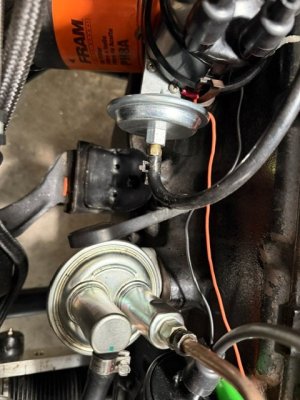
Dear Members,
Have been tinkering with the car. AS Frank indicated it was not a carb problem but an ignition one.
I did the tests recommended in the Ford manual and the results were very close to their specs:\Battery to coil test 6.76V
Starting ignition switch voltage .137v specs call for less that .1v
Coil to ground test .136 volts. Spec calls for less that .1 volts
Coil to distributor primary wire .139 volts
Movable breaker point to breaker plate .057v
Breaker Plate to distributor housing .006 volts
Distributor housing to block .005volts.
I repalced the condenser, points, wires and the car runs continuosly now.
I checcked the timing today and its at 10 deg btdc.
Enclosed some videos and pictures.
Still I hear a small hesitation that could probably indicate still some ignition gremlins.
Now its time to finish adjusting the carburetor.
Thank you all for all your assistace in getting me out of this predicament.
Regards
 

Attachments

Gents, I am back. Continue with ptoblems. From muy previous videos I though that the only thing left was to adjust the carburetor. Today I started the car without any problems hook up the Tach/Dwell and the dwell shoot up to 60+ degrees. Took the distributor cap off and checked the gap on the points and it was 0.026 in. Tried few mote times but the dwell did not change. Do not know whay the oscillation on the dwell comes from. Checked the distributor shaft and it is solid, it does not move at all.
In addition to that, I was not able to bring the RPM's from the fast idle down to idle speed (500 to 550 RPM) eventhough the car was at operating tempertature, these remained at 1300 RPM's. The fast idle screw was off the cam. Choke was fully open. Fuel mix screw did not decresae the RPM's.
PLease your comments are needed.
Thank you
 
I can't speak for the tach/dwell shooting up so high but the high idle sounds like a vacuum leak. Can you rule that out?

On that note, I found my carb had become loose the other day. Loose enough to move when I was actuating the throttle. I had already put locktite on the threads too. Weird. but expansion and contraction between steel, cast iron and aluminum are the likely suspects.
 
  • Like
Reactions: DON
I'm sorry there's more problems! I realize I've presented many unorthodox recommendations which you have justifiably been hesitant to pursue. None are made up or are "opinions", they have all been learned over a long period of time, because I'm a stubborn breed (and probably not too smart by normal standards) who has driven only old high mileage and hand me down vehicles since I got my license at 15, 51 years ago. Most have had, and still have, ignition points.
Sorry for the personal piece, it's here to encourage you to not shrug off what I'm about to present- it's legit:
The book recommended points gap setting is for new engines. Old and high mileage engines, this setting will be too wide of a points gap, for this reason: the points physically scrub the distributor rubbing block and over time the high points of the metal block which opens the points gets scrubbed down. Thus there is less total lift of the points off the seat than when new. The only way to know what the correct points gap is is by the dwell. On any 6 a dwell of 28*-32* is a balanced setting. After adjusting by dwell, then measure the gap and that is the now-correct setting for that particular vehicle. My current 63 year old car now likes a gap of .016", my 57 year old truck engine is correct @ .019". both are well below the book gap for a new engine. (both run like new). I once had a Chevy6 w/ 400K miles which ran a gap of .010".
One more thing- Changing the points gap changes ignition timing quite a bit. Wider points advance timing, closer points gap retards timing.
Last comment: engine operation can indicate if points are adjusted too wide/close: points too wide, the engine runs well at idle and low rpm, but will begin intermittent miss at high rpm. Points too close, engine may miss occasionally at idle and be hard to start, but will fire well at higher rpms, to the redline.

Your engine looks good, like that clean and neat look. (y) I hope you solve these issues quickly! :)
 
A dwell reading of 60* means the points are never opening, which is obviously not the case. Be sure your instrument is not grounding anywhere but the points wire, and is functioning correctly.
 
Back
Top