It gets 36* by 2500 rpms. I’ve adjusted the VA to engage with less vacuum of different amounts and it didn’t change anything noticeable performance wise. I ran it with no vacuum and it was the same.You don't have the ignition timing to allow the engine to spin up.
These 200's are gluttons for timing and your vacuum advance canister is not doing you any favours. I don't think my vacuum can requires such a high vacuum but I will have to read the spec on it. As @Frank mentioned, as soon as ported vacuum is initiated, the timing mark should jump ahead the prescribed amount.
I have experienced a similar situation with mine when I first put the new engine in my car. I didn't have enough initial timing and I chose to plug my vacuum advance and depend on mechanical advance (bad theory). It was a hard pull to get it to spin up and it fought me. As soon as I added port vacuum advance, it took right off.
Edit: The topic of valve springs is an aside to what’s going on with your engine. The stock springs are well known to be sub par for camshafts that need a fast spring. Cam manufacturers like Clay Smith offer springs that will match the requirements of the camshaft or you can use 302 and 289 springs depending on the spec of the camshaft. In your case, I am more than certain it’s timing so I wouldn’t suggest going down a shim or heavy spring rabbit hole until you get your ignition timing sorted out.

You are using an out of date browser. It may not display this or other websites correctly.
You should upgrade or use an alternative browser.
You should upgrade or use an alternative browser.
200ci Degree the cam?
- Thread starter Dustyford
- Start date
This applies only to 200ci

It gets 36* by 2500 rpms. I’ve adjusted the VA to engage with less vacuum of different amounts and it didn’t change anything noticeable performance wise. I ran it with no vacuum and it was the same.
36* by 2500 should be plenty. Mine is all in by about 2500 as well.
Have you tried bumping up the initial timing and is it advancing correctly when the engine comes off idle, now that you’ve made it advance with the canister with lower vacuum? I didn’t realize that was an adjustment you could easily change.
I found that mine wanted a bunch of vacuum advance as soon as I came off idle otherwise it would struggle to pull. Mine will idle at 14 degrees initial and when it comes off idle it jumps right up to 24 degrees and it accelerates effortlessly. It’ll spin up to 3,000 or 3,500 very quickly without a ton of pedal.
I’ve played with the initial a bit. No more than 14*. Doesn’t make a difference. The VA is adjustable with an allen wrench.36* by 2500 should be plenty. Mine is all in by about 2500 as well.
Have you tried bumping up the initial timing and is it advancing correctly when the engine comes off idle, now that you’ve made it advance with the canister with lower vacuum? I didn’t realize that was an adjustment you could easily change.
I found that mine wanted a bunch of vacuum advance as soon as I came off idle otherwise it would struggle to pull. Mine will idle at 14 degrees initial and when it comes off idle it jumps right up to 24 degrees and it accelerates effortlessly. It’ll spin up to 3,000 or 3,500 very quickly without a ton of pedal.
I basically have to floor it and hold to see 3500. I don’t need to rap it out ever but I’d like to know what it can and should do.
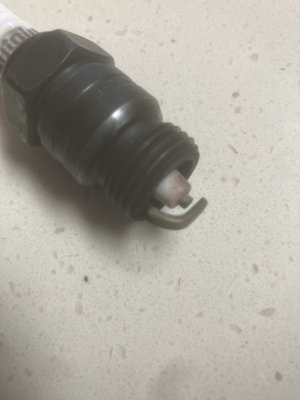
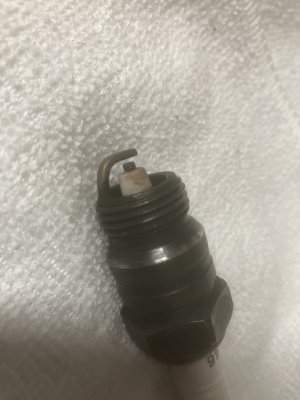
Do all six plugs look the same?Funny you should ask.
The picture is not real clear, the plug looks a little rich but nothing extreme.
It would be great if you had an air/fuel ratio meter so you could see what combustion is doing at WOT

Engine Fan
Well-known member
Does it possibly have exhaust back pressure?
It has full vacuum at cruise but I haven’t tested it with a deviceDoes it possibly have exhaust back pressure?
I only had one out to get TDC. No such tool in my repertoireDo all six plugs look the same?
The picture is not real clear, the plug looks a little rich but nothing extreme.
It would be great if you had an air/fuel ratio meter so you could see what combustion is doing at WOT
I feel your pain. Don't give up!It doesn’t get a vacuum response until at least 15” so probably only at cruise.
I am confused with the vacuum advance. Vacuum advance should be progressive. In other words, at say 12 inches of vacuum you should have some vacuum advance but not all of it. What you are saying is at 14" you have no vacuum advance and as soon as you get 15 it all jumps in. This does not make sense to me. Are you sure that the 15 does mean the vacuum advance is limited to 15 degrees of total advance?
The vacuum advance is only for cruising and light throttle when the engine is not working hard. Air density in the cylinder is low thus the burning of the fuel is slow thus more advance is required for efficiency not power.
The ways to determine this is to rev the engine to say 1500 with no load on the engine and measure the vacuum, then disconnect the vacuum to the distributor and the engine should slow down. This means there is some vacuum advance.
Another way is to connect the vacuum advance to manifold vacuum and set idle to say 700 rpm. Then disconnect the vacuum advance. Engine should slow down or maybe stall. This means the vacuum advance is working.
Another way is to get a hand held vacuum pump and connect it to the distributor vacuum can, pump up and watch the the arm of the can move. If done with the engine running the engine should speed up as you apply vacuum. There should be a noticeable speed change as vacuum is applied at less than 15" and should be progressive.
I suggest you stop worrying about the vacuum for what your describe as your problem, it should not have anything to do with it. The engine should run without the vacuum advance, just not efficiently at cruise.
First I think the cam timing is too retarded as I stated previously. The cam should be installed at 4 degrees advanced or at the most straight up.
Second, you should know and confirm the mechanical advance. Never take someone else word for it. "trust but verify". I think this is your problem as others have said. Mark your harmonic balancer with degrees and make sure at TDC of #1 the pointer is at 0.
When setting the mechanical advance, set the total advance first, say 36 degrees at 3000 rpm and then see where the idle winds up. Turning the distributor to set the idle advance will change the total and this could be your problem. If your idle advance is to low when setting the total advance connect the distributor to manifold vacuum and see if the engine speeds up as it should.
If setting the idle advance to say 14 degrees on ported vacuum with the distributor as been suggested, the total could be too far advanced depending on your mechanical advance curve. The total is the most important.
IMO many get the ported vs manifold vacuum wrong and when to use each. This is another topic for another thread.
Of course all this assumes the engine is healthy.

Just thinking, this is a reground stock cam. One barrel carb, stock log head. If I’m not mistaken, a second grind can’t be too much more aggressive than a stock grind, unless you start welding in more material, then grinding. Stock motors do fizzle out by 3500 rpm, maybe even before. I remember the feeling of needing to grab another gear by around 2500rpm, and I only had 3 to start with!! When I changed the carb to the 2 stage and DUI, it made the drivability better, still not a hot rod, but it would go to 3500 without the feeling of needing to shift. And that was with pretty much stock everything else on a tired engine.Hello all, I installed a reground original 60s cam earlier this year in my ‘65 200. I did not degree it. It is a mild performance grind. I was told bolt it in and go. It is a new rebuilt engine and doesn’t idle well, doesn’t accelerate well, has weak, unstable vacuum at idle and won’t rev over 3800. I have been chasing carb and ignition as the cause but maybe it’s the cam. Where can I find a cam degree kit for a 200? Thank you.
In short, there just might not be any more this engine can give in the current state, even with good compression, vacuum and advance.
Just a thought…

Hello all, I installed a reground original 60s cam earlier this year in my ‘65 200. I did not degree it. It is a mild performance grind. I was told bolt it in and go. It is a new rebuilt engine and doesn’t idle well, doesn’t accelerate well, has weak, unstable vacuum at idle and won’t rev over 3800. I have been chasing carb and ignition as the cause but maybe it’s the cam. Where can I find a cam degree kit for a 200? Thank you.
@DON might be right and we’re just asking too much from the engine with a small carburetor and small exhaust. I didn’t get the chance to experience mine with the 1 barrel and stock sized exhaust because it came to me as a non-running vehicle and I’m comparing my results to yours with a bigger carb (although restricted by the intake) and a header and less restrictive exhaust. My camshaft also is likely more performance oriented.
That said, even with the small carburetor and restrictive exhaust, it should idle smoothly and accelerate smoothly as well. There engines are known for being naturally well balanced.
@alwill923 posted some great advice regarding the alignment of your camshaft and getting the total total timing sorted out. We are assuming it’s around 4 degrees retarded from your earlier examinations. I have read some posts on this site where people have improved their under performing stock-ish engines by changing the timing of the camshaft. If you choose to go that route, here are some resources.
Here’s a link to the timing chain and adjustable gear set. You can’t avoid using an adjustable gear set if you want to get it on the mark and you can’t trust the markings; you have to get a degree wheel and dial indicator to know what’s going on.
I’ve only seen the adjustable gear set for the 200 from Clay Smith and from a distributor in Australia. Adjustable gear set: https://claysmithcams.com/product-id-jpp-200-drc-dual-roller-timing-chain-set-170-200ci/
The degree wheel can come from plenty of sources. Clay Smith has one of course and it comes with the solid lifters that you would usually use with the head off and everything exposed. That’s the way I set mine up but you may be able to do the measurements without pulling the head with advice from folks here.
Thank you and everyone else for your knowledge. I have a lot to think about. Dan Nolan of Glazier’s Mustang Barn recurved my distributor based on the engine, transmission, rear end, and new cam specs. He set it for 36* at 2800 rpm. He set the VA to engage at 15” so it would only have effect on cruising. He recommended 8-10* base timing. That’s what I can tell you. People have told me the 200 should rev to 6000, some say 3500 is pretty good. Maybe I am asking too much from it. The small 1100(1.1” Venturi and 58 jet) doesn’t give much performance. I may do a cam degree with the JP kit from Clay Smith. My cam looks to be very retarded so straight up or 2-4* advanced should help, especially with my altitude of 5500’. I have a very experienced engine builder friend to help although he is a Chevy guy. 
I feel your pain. Don't give up!
I am confused with the vacuum advance. Vacuum advance should be progressive. In other words, at say 12 inches of vacuum you should have some vacuum advance but not all of it. What you are saying is at 14" you have no vacuum advance and as soon as you get 15 it all jumps in. This does not make sense to me. Are you sure that the 15 does mean the vacuum advance is limited to 15 degrees of total advance?
The vacuum advance is only for cruising and light throttle when the engine is not working hard. Air density in the cylinder is low thus the burning of the fuel is slow thus more advance is required for efficiency not power.
The ways to determine this is to rev the engine to say 1500 with no load on the engine and measure the vacuum, then disconnect the vacuum to the distributor and the engine should slow down. This means there is some vacuum advance.
Another way is to connect the vacuum advance to manifold vacuum and set idle to say 700 rpm. Then disconnect the vacuum advance. Engine should slow down or maybe stall. This means the vacuum advance is working.
Another way is to get a hand held vacuum pump and connect it to the distributor vacuum can, pump up and watch the the arm of the can move. If done with the engine running the engine should speed up as you apply vacuum. There should be a noticeable speed change as vacuum is applied at less than 15" and should be progressive.
I suggest you stop worrying about the vacuum for what your describe as your problem, it should not have anything to do with it. The engine should run without the vacuum advance, just not efficiently at cruise.
First I think the cam timing is too retarded as I stated previously. The cam should be installed at 4 degrees advanced or at the most straight up.
Second, you should know and confirm the mechanical advance. Never take someone else word for it. "trust but verify". I think this is your problem as others have said. Mark your harmonic balancer with degrees and make sure at TDC of #1 the pointer is at 0.
When setting the mechanical advance, set the total advance first, say 36 degrees at 3000 rpm and then see where the idle winds up. Turning the distributor to set the idle advance will change the total and this could be your problem. If your idle advance is to low when setting the total advance connect the distributor to manifold vacuum and see if the engine speeds up as it should.
If setting the idle advance to say 14 degrees on ported vacuum with the distributor as been suggested, the total could be too far advanced depending on your mechanical advance curve. The total is the most important.
IMO many get the ported vs manifold vacuum wrong and when to use each. This is another topic for another thread.
Of course all this assumes the engine is healthy.
Thank you and everyone else for your knowledge. I have a lot to think about. Dan Nolan of Glazier’s Mustang Barn recurved my distributor based on the engine, transmission, rear end, and new cam specs. He set it for 36* at 2800 rpm. He set the VA to engage at 15” so it would only have effect on cruising. He recommended 8-10* base timing. That’s what I can tell you. People have told me the 200 should rev to 6000, some say 3500 is pretty good. Maybe I am asking too much from it. The small 1100(1.1” Venturi and 58 jet) doesn’t give much performance. I may do a cam degree with the JP kit from Clay Smith. My cam looks to be very retarded so straight up or 2-4* advanced should help, especially with my altitude of 5500’. I have a very experienced engine builder friend to help although he is a Chevy guy.
Glad to hear you've got resources. Chevy guys are great to have on hand. I was a chevy guy until I got my Mustang. He'll probably wonder why your ford is so darn smooth and want to change the firing order

Back to the camshaft... I don't know if it's just the variance they allowed back in the day or the sloppy attention to detail today but, on the 200, there is no "straight up" and every engine and camshaft will be out. There is no rule of thumb that it will b x degrees advanced or x degree retarded. You have to degree the camshaft to see where it actually is. Related to that I watched a bunch of videos about small block chev engines where the guy had timing chain sets from 5 manufacturers and every one was out advanced or retarded when bolted in straight up. I never used to degree camshafts when I was tinkering with chevy's. They ran ok but I wonder how much HP I left on the garage floor.
Regarding ignition timing, if you haven't already, you'll want to get a timing light and tachometer to see what the actual timing is when it's at idle, off idle, at 2000, at 3000. I'm pretty confident that Dan set it to advance all in to 36° at 2800 RPM but you need to actually check it.
Plug looks good. Nice tan color.
You can see the heat in the ground strap going from the tip to just below the bend. Good
Glad to hear you've got resources. Chevy guys are great to have on hand. I was a chevy guy until I got my Mustang. He'll probably wonder why your ford is so darn smooth and want to change the firing order
Back to the camshaft... I don't know if it's just the variance they allowed back in the day or the sloppy attention to detail today but, on the 200, there is no "straight up" and every engine and camshaft will be out. There is no rule of thumb that it will b x degrees advanced or x degree retarded. You have to degree the camshaft to see where it actually is. Related to that I watched a bunch of videos about small block chev engines where the guy had timing chain sets from 5 manufacturers and every one was out advanced or retarded when bolted in straight up. I never used to degree camshafts when I was tinkering with chevy's. They ran ok but I wonder how much HP I left on the garage floor.
Regarding ignition timing, if you haven't already, you'll want to get a timing light and tachometer to see what the actual timing is when it's at idle, off idle, at 2000, at 3000. I'm pretty confident that Dan set it to advance all in to 36° at 2800 RPM but you need to actually check it.
Glad to hear you've got resources. Chevy guys are great to have on hand. I was a chevy guy until I got my Mustang. He'll probably wonder why your ford is so darn smooth and want to change the firing order
Back to the camshaft... I don't know if it's just the variance they allowed back in the day or the sloppy attention to detail today but, on the 200, there is no "straight up" and every engine and camshaft will be out. There is no rule of thumb that it will b x degrees advanced or x degree retarded. You have to degree the camshaft to see where it actually is. Related to that I watched a bunch of videos about small block chev engines where the guy had timing chain sets from 5 manufacturers and every one was out advanced or retarded when bolted in straight up. I never used to degree camshafts when I was tinkering with chevy's. They ran ok but I wonder how much HP I left on the garage floor.
Regarding ignition timing, if you haven't already, you'll want to get a timing light and tachometer to see what the actual timing is when it's at idle, off idle, at 2000, at 3000. I'm pretty confident that Dan set it to advance all in to 36° at 2800 RPM but you need to actually check it.
Yes indeed. I know the 15” is correct because I hooked vacuum to the VA unitGlad to hear you've got resources. Chevy guys are great to have on hand. I was a chevy guy until I got my Mustang. He'll probably wonder why your ford is so darn smooth and want to change the firing order
Back to the camshaft... I don't know if it's just the variance they allowed back in the day or the sloppy attention to detail today but, on the 200, there is no "straight up" and every engine and camshaft will be out. There is no rule of thumb that it will b x degrees advanced or x degree retarded. You have to degree the camshaft to see where it actually is. Related to that I watched a bunch of videos about small block chev engines where the guy had timing chain sets from 5 manufacturers and every one was out advanced or retarded when bolted in straight up. I never used to degree camshafts when I was tinkering with chevy's. They ran ok but I wonder how much HP I left on the garage floor.
Regarding ignition timing, if you haven't already, you'll want to get a timing light and tachometer to see what the actual timing is when it's at idle, off idle, at 2000, at 3000. I'm pretty confident that Dan set it to advance all in to 36° at 2800 RPM but you need to actually check it.

There is still confusion here. VA does not do nothing then suddenly come in at 15". It varies timing with vacuum. In actual driving, vacuum moves with every throttle change and rpm change. It is a fun dash gauge to watch, it rarely is stationary. I've been driving off a vacuum gauge for decades. And, rarely will you have 15" of vacuum while cruising. That would be a light load flat road under 45mph. IF your VA can is not advancing below 15" manifold vacuum, this is a significant factor in your weak performance. And your symptoms agree with late ignition timing. Please forget the book, you need to find the best tune, and factory posted timing is conservative. It's rare to tune a well aged engine that does not end up with more ignition timing, sometimes a lot more, than "proper" specs.Yes indeed. I know the 15” is correct because I hooked vacuum to the VA unit
I'm not fussing here, just saying this needs to be looked into.
I'm going to ask you to try something. It's easy and will determine if timing is an issue: adjust your VA can all the way "on." Obviously don't force the screw after it bottoms, but turn it to the full advance stop. Take a drive. I'll wager an improvement, possibly significant.
Frank, Thanks for the input. I appreciate everyone. I’m more confused than anyone else.There is still confusion here. VA does not do nothing then suddenly come in at 15". It varies timing with vacuum. In actual driving, vacuum moves with every throttle change and rpm change. It is a fun dash gauge to watch, it rarely is stationary. I've been driving off a vacuum gauge for decades. And, rarely will you have 15" of vacuum while cruising. That would be a light load flat road under 45mph. IF your VA can is not advancing below 15" manifold vacuum, this is a significant factor in your weak performance. And your symptoms agree with late ignition timing. Please forget the book, you need to find the best tune, and factory posted timing is conservative. It's rare to tune a well aged engine that does not end up with more ignition timing, sometimes a lot more, than "proper" specs.
I'm not fussing here, just saying this needs to be looked into.
I'm going to ask you to try something. It's easy and will determine if timing is an issue: adjust your VA can all the way "on." Obviously don't force the screw after it bottoms, but turn it to the full advance stop. Take a drive. I'll wager an improvement, possibly significant.
 The VA works off ported vacuum which is zero at idle and increases off idle. At cruise my ported vacuum is around 18”. My VA was set to move the plates at 15” of ported vacuum, verified by my vacuum tool. The centrifugal advance is set to control all the acceleration timing advance. If I dropped the VA setting to 10” I would have 40* advance at 2000 rpm. I’ll try more adjusting and testing. I’ve tried just about everything fuel and ignition related over the last year.
Frank, Thanks for the input. I appreciate everyone. I’m more confused than anyone else.
I've kind of ignored it because I thought it was a typo but I'm surprised that your VA canister needs 15" of vacuum. I am certain that typical ford VA canisters require about 8"-10" of vacuum to start pulling advance. Chevy's start pulling as low as 5" (sorry... I was a Chevy guy in my formative years).
As @Frank suggested, ignore the books and look at how it reacts in the real world. These engines like a lot of timing. I mean a ton of timing, especially compared to the small block chevy's I dabbled with in my youth.
Currently, today, on paper, I have a maximum all in of 40° advance, all in. Six months ago on paper, I was running 50° all in maximum ignition timing.
The thing is, just because you have x amount vacuum advance and x amount mechanical on paper, doesn't mean it is additive. When the engine is under load, vacuum drops significantly and when it's not under load, the engine speed drops AND both VA and MA vary; they aren't on and off except when you come off idle with ported vacuum.
On the rare occasion at the right throttle position and the right engine speed, I probably approach the maximum amount of timing I have but at 14° initial + 10° VA + 18° MA, I have yet to ping my engine and I listen for it. When I had my initial timing at 24° there was a rare instance of pinging if the throttle was very close to closed and the engine speed was high enough to have lots of advance (5th gear on the highway coasting at close to 1200 RPM because traffic got congested) and that is why I slowly turned my back in little increments until I settled on where it is today.
One of our members here, @Otto went down a carburetion and timing rabbit hole this year and documented everything. I think he is in the Cascades so he has some altitude (2,000 - 3,000 feet if he's in the foothills). During his exploration, he spent some time seeing where his timing was and how it impacted timing/power/economy using an AFR gauge. He has an Econline so he pulled the engine cover and bumped the timing, advancing it as he went along on his test drive to see if he could get maximum power and economy without pinging. He never got it to ping and found that after that test he was up to 55° by 2000 RPM
 IIRC, he confirmed that with a timing light when he got home.
As I recall, @Otto determined that 36° all in at 2000 RPM was optimal for him and according to the AFR gauge, there was no benefits to be had with the extra timing, so that's where he set his back to. All that said, the timing for your engine is highly dependent on your engine, your altitude, carb, cam, etc... so you'll need to figure out what actually works.
Anyway, this is just a long roundabout way of letting you know that you won't know what works until you know. ...you know
I sure hope that doesn't muddy the waters. Your plugs look very nice so I'm confident that your carburetor is doing what it needs to do. Your camshaft might need to be advanced too but I would really start with getting timing light and a tachometer and document what is going on at the various speeds and throttle positions so we know that what you have on paper matches reality. I would like to see the initial timing and RPM then timing at 1000 RPM, 2000 RPM and 3000 RPM.
Dustyford- You're well informed, so that's good. The root of your weak performance is probably camshaft or valve spring related. However, vacuum controlled ignition advance plays a major role in snappy performance and fuel economy.
Ported vacuum IS intake manifold vacuum the moment the throttle blade exposes the port. If high idle vacuum is 20" (18 or so at your elevation), then the vacuum advance can sees 0" at idle. The moment the throttle is cracked opened the VA instantly goes from 0 to 20", or what ever the intake manifold vacuum is, immediately advancing the timing 15-25* (or where ever it is set for max advance) in addition to base timing + centrifugal timing. This is correct tuning.
The lighter the load, the more timing advance an engine needs. Vacuum is directly proportional to load at all times. Thus, a properly working vacuum ignition advance is a fine-tuner of ignition timing. It varies how much it advances as vacuum changes, working at all times if the throttle is above idle. It is a perfect judge: lighter load= more vacuum = more advance. Heavier loads = lower vacuum = less vacuum advance. WOT = 0" vacuum, no vacuum advance is added, correct for full throttle. . I've found that in an open combustion chamber engine, they perform best with generous vacuum advance tuned into the system.
One last question that we've all overlooked: does the engine try to run hot? Late timing, either ignition or camshaft, will cause the exhaust temperature to rise significantly. . . . And are you SURE there's no excessive exhaust back pressure- that can produce 100% of your symptoms.
Thanks for allowing us to take part in your query.
Ported vacuum IS intake manifold vacuum the moment the throttle blade exposes the port. If high idle vacuum is 20" (18 or so at your elevation), then the vacuum advance can sees 0" at idle. The moment the throttle is cracked opened the VA instantly goes from 0 to 20", or what ever the intake manifold vacuum is, immediately advancing the timing 15-25* (or where ever it is set for max advance) in addition to base timing + centrifugal timing. This is correct tuning.
The lighter the load, the more timing advance an engine needs. Vacuum is directly proportional to load at all times. Thus, a properly working vacuum ignition advance is a fine-tuner of ignition timing. It varies how much it advances as vacuum changes, working at all times if the throttle is above idle. It is a perfect judge: lighter load= more vacuum = more advance. Heavier loads = lower vacuum = less vacuum advance. WOT = 0" vacuum, no vacuum advance is added, correct for full throttle. . I've found that in an open combustion chamber engine, they perform best with generous vacuum advance tuned into the system.
One last question that we've all overlooked: does the engine try to run hot? Late timing, either ignition or camshaft, will cause the exhaust temperature to rise significantly. . . . And are you SURE there's no excessive exhaust back pressure- that can produce 100% of your symptoms.
Thanks for allowing us to take part in your query.
Similar threads
- Replies
- 11
- Views
- 1K


- Replies
- 20
- Views
- 2K

- Replies
- 14
- Views
- 1K