All Small Six Keeping the carb cool

This relates to all small sixes
Aluminum is a good conductor and will also conduct heat to the other side, steel would better, and better if mirror finish on the side to reflect heat away. A barrier of anything would be better than none.
I agree with what Frank said.
A little off topic here but I fould a PEEK capable printer for relatively cheap. If i get it and it can actually print well then I could make all the adapters/spacers out of peek or pekk which would eliminate the need for phenolic spacers. Aluminum has a heat transfer of about around 205 W/m·K while PEEK and PEEK adjacent materials have about around 0.25-0.29 W/m·K. The pps-cf10 is around .5 because of the carbon fiber in it. But either way a plastic based adapter insulates way better than the metal ones. How long the plastic lasts would be the only potential issue.

Anyone in here know someone who has had experience with PEEK? Not very many people have access to it. Its mostly used by engineering companies.
 
Anyone in here know someone who has had experience with PEEK?
You'd be better off machining blocks of PEEK.

You're looking at around $400 for 1.1 Lb of PEEK filament (half of a standard 1kg (2.2Lb) roll ~$20), one of the most EXPENSIVE printing materials that would take a 'not off the shelf' printer to even print it, heat enclosed print area and a print head that can get to the print temps of PEEK and not melt itself.

You then run into issues of proper layer to layer adhesion, and getting it printed 'air tight'.

I use a PLA plastic tube I printed up at 98% solid as an oil separation filter in my shop compressor.

Alternately, you could have PEEK printed up through a 3D print service, MUCH more simple and cost effective compared to trying to print PEEK at home.

My dad ran a 1" OAK spacer on a 300 for years.
 
Last edited:
Dashman Carb. Spacers. 608-637-7167. Phenolic.
 
Hey all, any luck with the heat shield? Photos if possible - I'm curious as I'm working towards the same setup.

I bought a phenolic spacer for my carb from an EBay seller. I couldn’t find a Weber phenolic spacer for the 38/38 but the EBay guy had one and it was a very well spent $20.00.

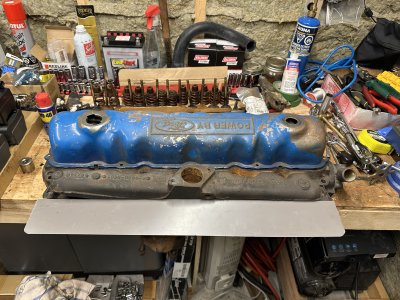
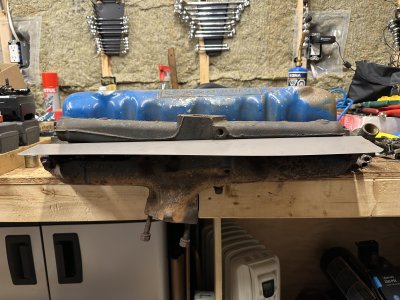
I did make a heat deflector out of a piece of house construction flashing but it’s still in my shop and not on the car yet. It’s 2 feet in length and about 4 inches deep. I’ll have to see how it works on the header. For now I mocked it up on my Large Log head with an old cast iron exhaust manuifold.

Excuse the messy shop. I need to do a really deep cleaning of it when I can. I radiused the sharp corners but I’d like to roll the edges to make it safer to be around. I think it will be wide enough to cover the header and deflect heat but well know for sure when the weather clears up and I can install it and check it out.

IMG_3754.jpeg

IMG_3755.jpeg
 
Mounted on the exhaust bolts?🤔
The exhaust manifold has a hump in it that the header doesn’t so rather than mount it behind the bolts, for mock up, i mounted it to the block between it and the manifold. I had intended to mount it to the studs after the header.

Now that I look at it though…

I wonder how much better it would deflect heat if I made one that was as long on the back side as an exhaust gasket, with cutouts for the exhaust and sandwiched it between the block and header. Because it would wrap right around the header, it should be more effective in preventing the heat from getting past it and up to the log than just hanging it off the back of the header studs.
 
The exhaust manifold has a hump in it that the header doesn’t so rather than mount it behind the bolts, for mock up, i mounted it to the block between it and the manifold. I had intended to mount it to the studs after the header.

Now that I look at it though…

I wonder how much better it would deflect heat if I made one that was as long on the back side as an exhaust gasket, with cutouts for the exhaust and sandwiched it between the block and header. Because it would wrap right around the header, it should be more effective in preventing the heat from getting past it and up to the log than just hanging it off the back of the header studs.
I may not be visualizing your concept variation (above) correctly, but if the steel starts wrapping around the heat source, then no, it will be less effective overall. The steel is a reflector. I learned from the woodstove, the reflected heat needs to be reflected away from the source. When it is pinned in tight to the heat source, and is parallel to it, then the heat is sent back into the source it started from and net reduction of heat in the immediate area is reduced.

The mockup you posted will work excellent IMO. The heat radiation is being reflected back into an open space that has airflow.
 
Interesting to note newer styles seem to fit close, but not fully enclose exhaust manifolds. Supporting Franks point👍
 
Sorry I meant that the shield would wrap around the top of the header much the way it wraps around the top of the exhaust manifold. I’ll see if I can get a bigger piece of flashing so I can mock it up correctly but it will look much the same as this one does.
 
Sorry I meant that the shield would wrap around the top of the header much the way it wraps around the top of the exhaust manifold. I’ll see if I can get a bigger piece of flashing so I can mock it up correctly but it will look much the same as this one does.
I got 'cha. One concern will be "buzzing" at specific RPMs. It may take some trial/error experimenting to the mounting arrangement to stifle the natural vibration frequencies. Regardless, this will be a great asset to intake/carb heat.
 
Interesting stuff👍. I would think if you just used a heavier piece of aluminum for the shield you could get rid of buzz🤔
 
Interesting stuff👍. I would think if you just used a heavier piece of aluminum for the shield you could get rid of buzz🤔

I was thinking aluminum first but earlier in the discussion, @Frank mentioned that he got extremely good results reflecting the heat for a wood burning stove with very light gauge steel and since I had some building flashing left over, I ran with it. I think if I use the reflective properties of the steel to deflect the heat away, I can add some of that material to the top to prevent it from buzzing. I’ll try it as is first.
 
Sorry, I have a roll of flashing that is aluminum. I just didn’t think about it possibly being steel. I would just keep an eye on it to make sure it doesn’t become unstuck😬
 
I was thinking too to incorporate a dampener. Fold it back it back on itself 2 or 3 times in the field. To make a flat z shape. Then fold the edges over or put a frame on it.
I was also thinking of using the nut rivets to make the shield removable from the mounting flange🤔
 
I was thinking too to incorporate a dampener. Fold it back it back on itself 2 or 3 times in the field. To make a flat z shape. Then fold the edges over or put a frame on it.
I was also thinking of using the nut rivets to make the shield removable from the mounting flange🤔

That’s a good idea. One could make some L-brackets out of a heavier gauge steel to bolt to the exhaust bolts or studs and then screw the top shield to the L-brackets. Then the top shield could be made from any number of materials and we could choose whatever works best. I think I’ll switch up the design to go that route. It would be easier to install too.
 
  • Like
Reactions: DON
Back
Top