Remote Turbo Setup & Falcon Sixes?

A little off the topic of engines but I have read where people have used an aluminum driveshaft out of an Explorer in their early Mustangs. So that will held get a little more power to the wheels. Any body have any recommendations for good 8 inch gear ratio for street use?
Changing the mass of the driveshaft will NOT affect performance, it may save a kilo or two. As to gear ratio in the 8 inch, my best compromise is 3.25 on 14 inch wheels, with a lot of torque you could pull anything up to 2.8:1. However the 8 inch is two pinion and may fail with enough torque. You can get LSD which I would advise.
 
Changing the mass of the driveshaft will NOT affect performance, it may save a kilo or two. As to gear ratio in the 8 inch, my best compromise is 3.25 on 14 inch wheels, with a lot of torque you could pull anything up to 2.8:1. However the 8 inch is two pinion and may fail with enough torque. You can get LSD which I would advise.
I'm not sure how big a difference the size of the wheels make but I was hoping to use "non-dished" 17 inch rims with some spacers to accommodate wider tires. However, I do already have a set of 14" alloy Ranger rims.
 
Last edited:
I'm not sure how big a difference the size of the wheels make but I was hoping to use "non-dished" 17 inch rims with some spacers to accommodate wider tires. However, I do already have a set of 14" alloy Ranger rims.
Its the rolling radius of the tyre that determines the actual ratio relative. 3.25 on 205 70 r14s is my favourite, that tyre has a rolling radius of 320mm. So its gives an rpm in a direct gear of 2400 at 80km/h. For 17s its depends on the profile and size. I find if you are doing around 2900rpm at 100km/h thats seems about right. An engine with high torque at lo rpm can pull higher gears. I do not like the low profile tyres on the older cars, those type of tyres need to be kept flat on the road, the older suspensions have a lot of camber change which wont keep the tyre flat. IMO keep with a profile above 60 for these cars, it also gives a better ride. You can do quite a lot of improvements to the stock early falcon/Mustang suspension without resorting to an entirely new and expensive front end. Please do not use spacers, this loads up the bearings, the centre of the wheel is supposed to be between the two bearings on the front and right under the rear wheel bearing, it also changes the scrub radius on the front.
 
Loosing weight is always good. The more the better, a little not so much, but it all adds up.
I only lost 2 lbs going to AL drive shaft mostly because its only about 24'' long and I upgraded to the larger heavier 1350 series U joints, yokes and shaft tube diameter. Breaking a U joint can be very dangerous at high speed, Luckily the stock one broke on take off.
 
Last edited:
Loosing weight is always good. The more the better, a little not so much, but it all adds up.
I only lost 2 lbs going to AL drive shaft mostly because its only about 24'' long and I upgraded to the larger heavier 1350 series U joints, yokes and shaft tube diameter. Breaking a U joint can be very dangerous at high speed, Luckily the stock one broke on take off.
From what Ive gleaned in my days is that, Aluminium shafts are used to save some mass, and reduce "ringing" within the shaft at certain speeds, this is why some steel shafts have cardboard sleeves inside them. A lot of modern cars use two piece shafts with a centre bearing, this reduces the need for a large diameter tube (whirling failure) and thus the size of the floor tunnel. As you've said the mass savings is insignificant. Breaking a UJ is a problem especially the front one, Ive seen the damage this can do, its BAD, Ive also seen the damage a whirling failure can do, its worse. As an interesting note, the Australia Ford territory has a two piece shaft (Steel) with a centre bearing, the bearing housing has a short cable attached to it to prevent the bearing dropping far enough to lock up the UJ and smash itself to bits, Ive not seen this on any other car. https://en.wikipedia.org/wiki/Ford_Territory_(Australia)
 
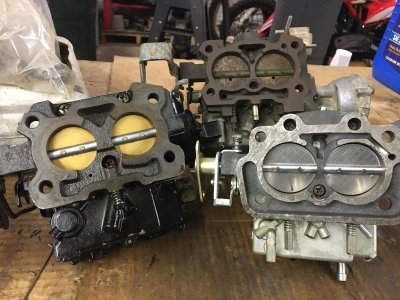
Also, should I try to have a 2 barrel conversion done on the log or since I'm planning on forced induction, will an adapter be good enough?
If you can do the conversion on the manifold, each barrel of the 2 barrel carb can flow straight down into the intake manifold.
An adapter will bottle neck the carburetor and be a restriction.
 
If you can do the conversion on the manifold, each barrel of the 2 barrel carb can flow straight down into the intake manifold.
An adapter will bottle neck the carburetor and be a restriction.
Will the adapter cause problems with forced induction specifically or would it just be ideal to do the conversion?
 
I've got to find a good machine shop here in GA. I know it is going to vary from shop to shop, but any heads up on the cost of this conversion as well as having larger valves installed?
Everyone on this this forum that has done the conversion has done it themselves so no cost estimates on that part of the project.
You will have to talk to whatever shop you find as to the cost of installing larger valves.

What year 250 cylinder head do you have?
The later heads already have the larger 1.750" intake valve.
 
Last edited:
Great advice here from @pmuller9 and @63 Sprint. Doing this project on a budget means starting at phase one and ironing out all the kinks. If you're happy with the setup, but want more power and are ready to start spending $$, then you can start planning phase 2+. The woeful log intake setup on these engines means that they respond VERY well to a small amount of boost vs trying to pull fuel & air through the log at vacuum. There are folks on here running 5 lbs of boost from a supercharger who are happy with that increase in power and drivability. A 300-400 hp engine is certainly attainable, but it will be expensive. Like they always say, "Power costs money. How fast do you want to go?" And of course, it's going to cost more money for less hp by using the six as a starting point vs a V8.

I have always thought that the abundance of room in the six engine bay would lend itself to a turbo setup quite nicely. Running a 5 psi turbo right off the stock exhaust manifold wouldn't require an intercooler and the whole setup wouldn't take up much room. Using a header with a crossover(under) pipe and mounting the turbo on the passenger side of the engine would allow for even more room for external wastegate plumbing, etc. Once that was dialed in, if more power was "needed", adding an intercooler and upping the boost to 8-10 psi could be the next step, and that would set up the foundation for later mods, like a cam, built block, etc.

I used to have a supercharged, flex-fuel swilling Infiniti G35. First phase, we built it to about 420 whp. It was a lot of fun, and my daily driver. Then I got used to the power and wanted more - cue phase 2: smaller pulley, lots of tuning tweaks, now about 480 whp. Now it was a riot. But of course - I got used to the power and, you guessed it, wanted more. On to phase 3: built motor, bigger intercooler, even smaller pulley, bigger injectors, more tuning, and a lot more cash. Final result - 560 hp at the wheels. Broke axles. Broke a transmission. Car was now a smoke machine that couldn't hook up the tires even with drag radials because the rear suspension was not built to handle anywhere near that level of power. Long story, but the point is that there is such a thing as too much in a regularly driven street car. Depends on what the chassis and driveline parts can handle. That car was an absolute blast at phase 2, and unmanageable at phase 3.

None of this is meant to dissuade you from pursuing a turbo project - I think it's an awesome idea and have fantasized about it many times myself. Just be sure to plan a realistic project for your skillset, budget, and needs, so that you don't get discouraged halfway through. This forum is a wealth of knowledge and encouragement, and as you've noticed already, there are lots of people here willing to help, from planning all the way to completion and beyond.

 
Everyone on this this forum that has done the conversion has done it themselves so no cost estimates on that part of the project.
You will have to talk to whatever shop you find as to the cost of installing larger valves.

What year 250 cylinder head do you have?
The later heads already have the larger 1.750" intake valve.
Okay gotcha. What are the steps to this conversion and what is needed or have these people just owned CNC equipment?

It is a '73 head
 
Okay gotcha. What are the steps to this conversion and what is needed or have these people just owned CNC equipment?

It is a '73 head
No CNC machining
Most are done with hand held tools

I've seen one member use a die grinder to cut the intake carburetor mount down to where it opens up

Another example:
 
Last edited:
Back
Top