All Small Six Back in the Saddle

This relates to all small sixes
Would you consider using the Ford 300 connecting rods, 6.21" rod length with a custom piston with a 1.300" CH?
Then you could adjust the compression ratio with the piston dish volume and have good quench.

A mechanical lifter camshaft with valve lift near .600" and a .050" duration around 230 degrees on a 108 LSA would give you plenty of power.
A roller mechanical would be even better.
The compression ratio would be close to 10:1
 
Last edited:
I think that to get .600'' lift on a 200/250 head, one would need to check clearance from retainer to valve seal. Taller valves may be needed and better than making a short guide shorter.
 
I think that to get .600'' lift on a 200/250 head, one would need to check clearance from retainer to valve seal. Taller valves may be needed and better than making a short guide shorter.
Yes, the valves are short.
We ran into that problem with the VI alloy head.
Manley was kind enough to make longer valves.
 
Which serpentine balancer did you go with for the 250, 4.6 ford, or the 96 (I think) big six?
 
Which serpentine balancer did you go with for the 250, 4.6 ford, or the 96 (I think) big six?
I want to say it was the 96 300 balancer. It fit right on like a charm. That said, I didn't try to verify timing mark lines up correctly, but that's an easy fix down the road. I believe it's a 6 rib balancer as stated in the past by someone as opposed to 8.
 
Would you consider using the Ford 300 connecting rods, 6.21" rod length with a custom piston with a 1.300" CH?
Then you could adjust the compression ratio with the piston dish volume and have good quench.

A mechanical lifter camshaft with valve lift near .600" and a .050" duration around 230 degrees on a 108 LSA would give you plenty of power.
A roller mechanical would be even better.
The compression ratio would be close to 10:1
I wasn't planning on changing the rotating assembly since my goal isn't a racer. I wouldn't want to make that build with an iron head anyway, I would go with either a VI or an Arg head in that case. Both options there have drawbacks that I don't want to go down currently. The roller cam is mostly a can I find a way to do this that someone with reasonable mechanical ability can do while increasing reliability and performance. Flat tappet lifters have been kind of hit or miss for awhile now from the stories I hear, couple that with the need for high ZDDP oil are making me want to get that figured out. That said, roller lifters are a LOT more expensive! LoL
 
Well, I wasn't able to get a good picture today, but what I'm running up against is that there isn't enough room against the block wall for the link retainer. Do you happen to know how wide those Morel lifters are at the retainer?
The lifters come with the open tie bar end on one side specifically for the Ford inline six.
They are sold by Straub Technologies.

These are what I ordered to try to do a fitment check: https://www.summitracing.com/parts/cca-836-16/make/ford

Don't worry - I didn't order a whole set. I got 2 individual lifters and a link LoL

There is no recess for the link like what you show in that Morel lifter. I'm wondering if maybe those might actually fit. I went with those COMP ones because of the removeable link but those Morel might actually work if they are narrower at the link than these. I may have to contact Straub to find out if it's possible to just get one set so that I can play around...
 
Well, I wasn't able to get a good picture today, but what I'm running up against is that there isn't enough room against the block wall for the link retainer. Do you happen to know how wide those Morel lifters are at the retainer?


These are what I ordered to try to do a fitment check: https://www.summitracing.com/parts/cca-836-16/make/ford

Don't worry - I didn't order a whole set. I got 2 individual lifters and a link LoL

There is no recess for the link like what you show in that Morel lifter. I'm wondering if maybe those might actually fit. I went with those COMP ones because of the removeable link but those Morel might actually work if they are narrower at the link than these. I may have to contact Straub to find out if it's possible to just get one set so that I can play around...
Chris Straub was willing to ship a set for testing if you wouldn’t mind contacting him. He was also curious whether roller lifters would work with the small sixes. I was too far along with my engine build and didn’t want to tear it back down, so I wasn’t able to test it myself.
 
The diameter of the Morel hydraulic lifter body is .874"
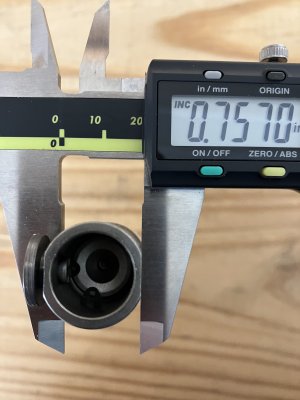
The lifter body diameter between the flats is .757"
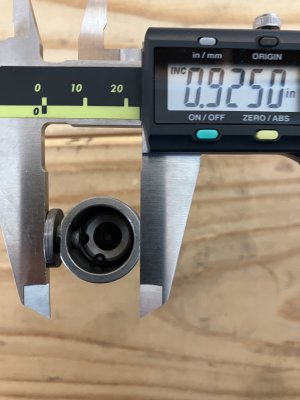
The Button for the tie bar end plus the flats is .925"

My math shows the top of the button sticks beyond the round lifter body 0.1095"


1770744968087.jpeg
1770745020168.jpeg
 
Last edited:
Yeah...That's a LOT smaller than this bad boy. The lifter diameter itself is 0.874 just like Morel. However at the tie bar it is 1.1395". Granted, this COMP lifter doesn't have the flat. So doing some back of the napkin math, adding back in that crescent, the COMP lifter is about 0.156" wider at the button than the Morel. I did reach out to Straub Tech and they were willing to break up a set and sell me 2 individual lifters with a link. So I'll give them a call here today and get that on order. Then we'll play the game of trying to get the link connected and see what kind of mechanical interference I end up with...
 
Oh, and since I have a couple of 200 blocks available, I'll see if I can get the rollers to link up in there too...
See the pictures sequenced 4, 5, 6 and 7 on page 17 at Stangnet.

It's a fairly heroic hole saw cutting exercise, but it definitely works. I helped Mike find Jaguar guy Dean Teigue in Australia to make a new cam from his existing masters, and then it was just a case of using the NASCAR 351 solid rollers with the 429/460 tie bar dimensions, do a quick pre 1963 a solid lifter oil re-route by drilling the oil feed in the seventh bearing like a pre 63 (to secure the lifter supply ) and use 12 oil through the 9.62" FE pushrods.

See "https://www.stangnet.com/mustang-fo...e-spoiler-a-car-that-never-was.871263/page-17"
 
See the pictures sequenced 4, 5, 6 and 7 on page 17 at Stangnet.

It's a fairly heroic hole saw cutting exercise, but it definitely works. I helped Mike find Jaguar guy Dean Teigue in Australia to make a new cam from his existing masters, and then it was just a case of using the NASCAR 351 solid rollers with the 429/460 tie bar dimensions, do a quick pre 1963 a solid lifter oil re-route by drilling the oil feed in the seventh bearing like a pre 63 (to secure the lifter supply ) and use 12 oil through the 9.62" FE pushrods.

See "https://www.stangnet.com/mustang-fo...e-spoiler-a-car-that-never-was.871263/page-17"

What a saga… Did he ever complete the build? Last post in 2020 says the transmission was seized and he needed to pull it out to reindex a clutch. I’d be hesitant to holesaw the block and make a cover that sealed properly. Seems like a way to introduce weakness into the block.
 
See the pictures sequenced 4, 5, 6 and 7 on page 17 at Stangnet.

It's a fairly heroic hole saw cutting exercise, but it definitely works. I helped Mike find Jaguar guy Dean Teigue in Australia to make a new cam from his existing masters, and then it was just a case of using the NASCAR 351 solid rollers with the 429/460 tie bar dimensions, do a quick pre 1963 a solid lifter oil re-route by drilling the oil feed in the seventh bearing like a pre 63 (to secure the lifter supply ) and use 12 oil through the 9.62" FE pushrods.

See "https://www.stangnet.com/mustang-fo...e-spoiler-a-car-that-never-was.871263/page-17"
Good grief! How many different places did Mike have that thing cross-posted! LoL Last I tracked that build was when he jumped ship here and went to 4eyedpride, and that forum completely disappeared...
 
In its turbo and un-turboed 250+ AOD, it worked great. But the block,which was sleeved, was then resleeved with thicker sleeves a second time at cost by the original machinist; then it leaked coolant via the sleeves and became a Dumpster item.

Then he followed his heart, and the 2JZE+ 4LE80 worked right away, with a Third link torque rod rear suspension. Really kicked the 250 Turbo Cross flows ass, but Then , it was running 18 pounds of boost and 7000 rpm plus...he wanted to pull a lot more revs and boost than just 6000 rpm on the original Maverick block. Then, the 2JZE was all perfect and, voom, he sold it and he is currently incognito. Every post he did was a winner, and it was fun watching him do the same at Stangnet that he did a Ford Six and Four Eyed Pride 🍿🌀=πø 😋.

I like it here too. 🕴️🕳️
 
Last edited:
In its turbo and un-turboed 250+ AOD, it worked great. But the block,which was sleeved, was then resleeved with thicker sleeves a second time at cost by the original machinist; then it leaked coolant via the sleeves and became a Dumpster item.

Then he followed his heart, and the 2JZE+ 4LE80 worked right away, with a Third link torque rod rear suspension. Really kicked the 250 Turbo Cross flows ass, but Then , it was running 18 pounds of boost and 7000 rpm plus...he wanted to pull a lot more revs and boost than just 6000 rpm on the original Maverick block. Then, the 2JZE was all perfect and, voom, he sold it and he is currently incognito. Every post he did was a winner, and it was fun watching him do the same at Stangnet that he did a Ford Six and Four Eyed Pride 🍿🌀=πø 😋.

I like it here too. 🕴️🕳️
I’m sad to hear the sleeves didn’t work out. He mentioned his worries about sleeving it and the potential for water leaking into the sump without any way to know until after the fact. That’s a shame. It was such a cool looking build and the roller lifters and semi open lifter bay really caught my eye. And yes… a 2JZE would be a more suitable and cost effective platform if we are being sensible about getting the best return on investment.

Back to the topic of high reving little Ford 6’s: Under load, my 200 seems capable of pulling cleanly to 5,500 (with stock valve springs) if my circa 1985 tachometer is to be believed. Clay Smith says the hydraulic lifter camashaft is good for 5,500 so that’s fine but there are pre-cross flow Australian and Argentinian small 6’s that pull to 7,000 and higher. Those engines are intriguing. I didn’t save the video but there was a YouTube video I saw last year of an early 70’s cortina with a pre-cross flow Aussie engine doing a hill climb course and at one point in the video, he was shifting at above 7,000 RPM. He might have been at 7,500. How do those engines rev so high without coming apart? There are loads of videos of screaming Argentinian little 6’s pulling outrageous revs as well. It’s inspiring :cool:
 
Back
Top