Original rear end was 3.20. Yes I installed an 8”. 3.55Question:
• Are you able to post the rear axle code from the vin tag?
I would like to check what the original axle ratio is.
Added:
I read in one of your posts a while back that you were talking about the possibility of removing the 7.5” rear and replacing it with an 8” rear. Did you change out the rear?

You are using an out of date browser. It may not display this or other websites correctly.
You should upgrade or use an alternative browser.
You should upgrade or use an alternative browser.
200ci Degree the cam?
- Thread starter Dustyford
- Start date
This applies only to 200ci
Third gear WOT at 2500 rpm. Vacuum dropped to 1”, at 3000-3”, at 3500-4”.Give us two readings.
3” vacuum. Start at 2,500 rpm’s and get readings at 3,000 rpm and 3,500 rpm’s
Try third gear. If third gear is too low or high, then try a different gear
It hit 3” at 3,000 rpm
Updates on what Sprint?Dustyford,
Do you have any updates?
Dustyford,
Do you have any updates? I thought we were done for now.
Oops. Sorry. I don’t know what I’m doing. I was waiting for suggestions from you on carb.Updates on what Sprint?

Did you figure out what course of action that you want to take with carburetion?
We know that the small log manifold is restricted. Did you want to keep the small log head stock, modify it for a 2 Barrel carb or find a large log head and modify it for a 2 barrel carb?
We know that the small log manifold is restricted. Did you want to keep the small log head stock, modify it for a 2 Barrel carb or find a large log head and modify it for a 2 barrel carb?
Here is some good reading:
This tech archives will help new members understand the differences of small block 6 heads. My understanding is, the small log heads are so restricted that there is not much to gain from installing performance parts. The small log head manifold has small valves on top of the restricted manifold. Even if the manifold is modified for a 2 barrel, the valves will only flow so much. In a nutshell, if anyone is looking to gain performance, it would be best to find a later year big log head with the larger valves and have it worked.
This tech archives will help new members understand the differences of small block 6 heads. My understanding is, the small log heads are so restricted that there is not much to gain from installing performance parts. The small log head manifold has small valves on top of the restricted manifold. Even if the manifold is modified for a 2 barrel, the valves will only flow so much. In a nutshell, if anyone is looking to gain performance, it would be best to find a later year big log head with the larger valves and have it worked.
Last edited:

thinking about @Dustyford ‘s conundrum, I wonder what the simplest, cost effective solution to his CFM deficit is.
I know the realities of the restrictions on a stock small log head but I have been quite happy with the 2v carb upgrade with the funnel shaped adapter. The adapter is not optimal and the small log head is even less optimal but it is an improvement over stock and I don’t have a problem with pulling revs out of my engine. I am at sea level.
The Weber and adapter is a bit of an investment so I don’t want to recommend that if there’s another more cost effective route for improvement.
What about a Carter YF rated at 187 CFM for the 200 or 195 CFM for the 250 or the later Carter RBS rated at 215 CFM for the 250. Even if the inlet bore on the 200 has to be enlarged it would be worthwhile and achievable with a die grinder (I’ve seen photos: HERE).
I know the realities of the restrictions on a stock small log head but I have been quite happy with the 2v carb upgrade with the funnel shaped adapter. The adapter is not optimal and the small log head is even less optimal but it is an improvement over stock and I don’t have a problem with pulling revs out of my engine. I am at sea level.
The Weber and adapter is a bit of an investment so I don’t want to recommend that if there’s another more cost effective route for improvement.
What about a Carter YF rated at 187 CFM for the 200 or 195 CFM for the 250 or the later Carter RBS rated at 215 CFM for the 250. Even if the inlet bore on the 200 has to be enlarged it would be worthwhile and achievable with a die grinder (I’ve seen photos: HERE).
Did you figure out what course of action that you want to take with carburetion?
We know that the small log manifold is restricted. Did you want to keep the small log head stock, modify it for a 2 Barrel carb or find a large log head and modify it for a 2 barrel carb?
I am considering options. Keeping cost down and originality are priority. Thanks for the input.thinking about @Dustyford ‘s conundrum, I wonder what the simplest, cost effective solution to his CFM deficit is.
I know the realities of the restrictions on a stock small log head but I have been quite happy with the 2v carb upgrade with the funnel shaped adapter. The adapter is not optimal and the small log head is even less optimal but it is an improvement over stock and I don’t have a problem with pulling revs out of my engine. I am at sea level.
The Weber and adapter is a bit of an investment so I don’t want to recommend that if there’s another more cost effective route for improvement.
What about a Carter YF rated at 187 CFM for the 200 or 195 CFM for the 250 or the later Carter RBS rated at 215 CFM for the 250. Even if the inlet bore on the 200 has to be enlarged it would be worthwhile and achievable with a die grinder (I’ve seen photos: HERE).
I understand that originality is important to you and I respect that.
If you are still dissatisfied with the outcome then we can go from there. The good thing is you do have a big log head stashed away if you want to increase performance further than the stock small log head. You can always store the small log head. If the car is sold later in life. At least the car will have a period correct head for a new owner.
At least you have some options.
If you are still dissatisfied with the outcome then we can go from there. The good thing is you do have a big log head stashed away if you want to increase performance further than the stock small log head. You can always store the small log head. If the car is sold later in life. At least the car will have a period correct head for a new owner.
At least you have some options.
Last edited:
Some have used the Autolite 1101 for replacement but not sure if it is a compatible throttle linkage. The 1101 for 1969 Mustang 250 cubic inch was 210 cfm and did not have Spark Control Valve. Also it may not be readily available but since you have other things to address you could look around maybe on ebay all kinds of stuff shows up there or one of the major carb rebuilders such as Mikes or National.I am considering options. Keeping cost down and originality are priority. Thanks for the input.
Some have used the Autolite 1101 for replacement but not sure if it is a compatible throttle linkage. The 1101 for 1969 Mustang 250 cubic inch was 210 cfm and did not have Spark Control Valve. Also it may not be readily available but since you have other things to address you could look around maybe on ebay all kinds of stuff shows up there or one of the major carb rebuilders such as Mikes or National.
I think the Autolite 1101 a good option too if you can find a 1969 version of it. I didn’t realize that they came without the spark control valve but the Falcon book confirms exactly what you said about the 1969 version for the 250.
I took a moment to check EBay, National Carburetor, Carb Doctor, Mike’s, etc… and an Autolite 1101 without spark control valve seem difficult to come up with. Maybe someone in the classifieds has one though.
Practically speaking, I think a Carter RBS is going to be an easier and less costly option. In terms of originality, I think @Dustyford has a 1965 Mustang that’s been upgraded with a modern 5-speed and 1968 carb and distributor so putting on a 70’s Maverick carburetor like a Carter RBS wouldn’t be a big departure in the sense of originality. The RBS has a different linkage and probably a different fuel inlet but on the upside, you can find them for $60 on EBay and you can get rebuild kits at all of the usual suspects. Even if I simply wanted to sanity check my theory about a CFM deficit, that’s the direction I would take.
After that, it’s a slippery slope and before too long, you’re into a header, a Weber and you’re building a ported large log with big valves over the winter season

The reason why some of us are starting to look at the Stromberg Big97 is, it’s available, it’s made in the USA, it’s 250 CFM and the distributor gives good support. Sometimes it’s best to spend the extra dollars instead of being a penny pincher and not knowing what you’re getting.
The reason why some of us are starting to look at the Stromberg Big97 is, it’s available, it’s made in the USA, it’s 250 CFM and the distributor gives good support. Sometimes it’s best to spend the extra dollars instead of being a penny pincher and not knowing what you’re getting.
That’s a neat looking carb. For a short time, I had an inline-6 Mercedes with a tri-power stromberg setup in the 80’s. It was very dependable.
Now we’re into 2-barrel carburetor territory so, if I were going to spend some money and put on a 2-barrel (without modifying the head) then without hesitation, I’d drop a Redline/Weber kit on the car. It comes with the adapters, fuel pressure regulator and linkage to adapt it to your car and the kit is designed for the ford 200 inline 6. You only need to add a length of fuel line.
The Weber 32/36 is the popular choice for engines without a big camshaft and a big header and exhaust. It’s a progressive setup it usually runs around on the primary 32mm barrel; the 36mm barrel opens up when your into more spirited driving. I’ve seen claims that it flows 330 CFM but I believe that is calculated with 3” of vacuum. If it is calculated at 1.5” of vacuum it is more likely to flow 233CFM.
https://www.vintageinlines.com/product-page/32-36-weber-dgv-2v-carb-swap-kit-electric-choke
I have the 38/38 version of this kit and it was pretty much bolt on, adapt the linkage to work and go. I would reach out to them and ask for a suggestion on jetting for your altitude too.
I’d also recommend buying a phenolic spacer to provide a thermal break between the carb and the adapter. That allowed me to get my best lean idle. Prior to that, in order to combat the heat, I had to run it slightly richer than I’d like and I changed my idle jets back and forth trying to get it right. The phenolic spacer was $20 and solved that issue.
The reason why some of us are starting to look at the Stromberg Big97 is, it’s available, it’s made in the USA, it’s 250 CFM and the distributor gives good support. Sometimes it’s best to spend the extra dollars instead of being a penny pincher and not knowing what you’re getting.
I got a little carried away with my recommendation for a Weber carb and kit, which was more pointed towards @Dustyford if he choses to go into 2V territory. I still suggest looking at a Carter RBS to support the almost certain CFM issue he's facing and for a stockish 200, it might be all that's necessary.
All that aside, I am curious about the Stromberg Big97 you suggested. I was unaware of that carb as a small six option until you posted it but it looks like a decent piece of hardware. I haven't looked further into it but looks like it fits into the Weber 32/36 - 38/38 slot quite nicely. Seems like a good option. I wonder what kind of adapter will be necessary and whether Vintage Inlines or Clifford Performance 6=8 will take up the challenge of putting a kit together with the necessary bits.
Looks good. New and US made so that is a plus. I did not see dimensions on their site like the base dimensions and height which could be relevant info.The reason why some of us are starting to look at the Stromberg Big97 is, it’s available, it’s made in the USA, it’s 250 CFM and the distributor gives good support. Sometimes it’s best to spend the extra dollars instead of being a penny pincher and not knowing what you’re getting.
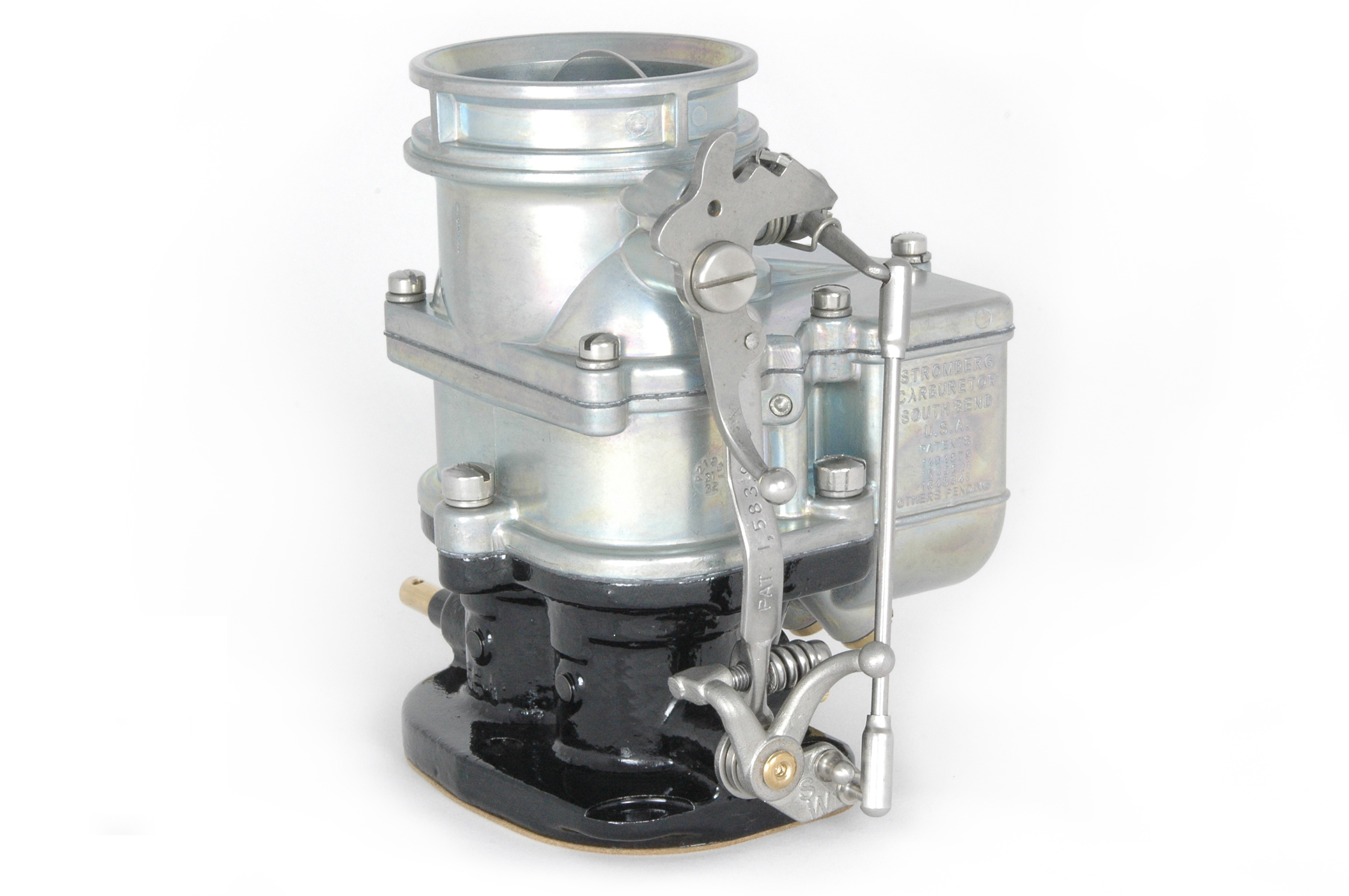
BIG97 Primary carburetor
 stromberg-97.com
Similar threads
- Replies
- 11
- Views
- 1K


- Replies
- 20
- Views
- 2K

- Replies
- 14
- Views
- 1K