Only one nippleIf there are two vacuum nipples on the distributor vacuum advance canister- do NOT use the inner one that faces up. Don't plug it either. Use only the outer horizonal vacuum nipple.

You are using an out of date browser. It may not display this or other websites correctly.
You should upgrade or use an alternative browser.
You should upgrade or use an alternative browser.
200ci Degree the cam?
- Thread starter Dustyford
- Start date
This applies only to 200ci

Frank,
I need to clarify something that you written in post #180. “If there are two vacuum nipples on the distributor vacuum advance canister, do NOT use the inner one that faces up. Don't plug it either. Use only the outer horizonal vacuum nipple.”
Being around working on many vehicles with 170 and 200 engines. And owning Falcons manufactured in 1968 and 1969, I do know a thing or two about them. In the late 1960’s the engines that had dual port distributors, did not have an outer horizontal vacuum nipple.
Here is what they had:
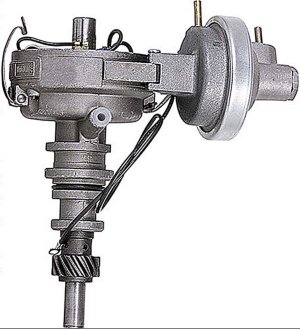
I felt I needed to clear this up so others will not get confused about what was written earlier. Ford made numerous different distributors throughout the years for the 170 and 200 engines and I’ve never seen an original OEM dual port distributor canister with a port on the end of the canister on any vehicle that Ford built in the late 1960’s. It looks like Ford might of updated the dual port distributor vacuum canister with a horizontal port on the end later-on. But, the original OEM canister was not built that way.
What Dustyford is referring to as a dual advance distributor is, it has both mechanical and vacuum advance.
To help clarify what vacuum advance canister the distributor has, here is a snapshot of a picture that Dustyford posted in post #102.
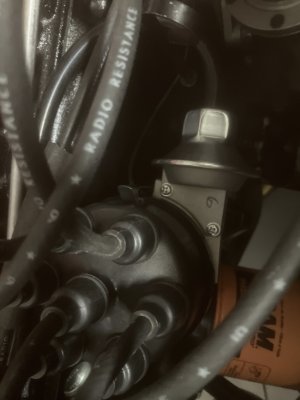
I need to clarify something that you written in post #180. “If there are two vacuum nipples on the distributor vacuum advance canister, do NOT use the inner one that faces up. Don't plug it either. Use only the outer horizonal vacuum nipple.”
Being around working on many vehicles with 170 and 200 engines. And owning Falcons manufactured in 1968 and 1969, I do know a thing or two about them. In the late 1960’s the engines that had dual port distributors, did not have an outer horizontal vacuum nipple.
Here is what they had:
I felt I needed to clear this up so others will not get confused about what was written earlier. Ford made numerous different distributors throughout the years for the 170 and 200 engines and I’ve never seen an original OEM dual port distributor canister with a port on the end of the canister on any vehicle that Ford built in the late 1960’s. It looks like Ford might of updated the dual port distributor vacuum canister with a horizontal port on the end later-on. But, the original OEM canister was not built that way.
What Dustyford is referring to as a dual advance distributor is, it has both mechanical and vacuum advance.
To help clarify what vacuum advance canister the distributor has, here is a snapshot of a picture that Dustyford posted in post #102.
Last edited:
I did exhaust and manifold vacuum tests today. I dropped the exhaust pipe from the manifold after warming it up. I could only get it to rev to 3500 in second gear, less than with the exhaust connected. (3700)Dustyford to do & check off list:
(tests and findings will be posted here for reference)
Engine Initial Timing 10-12 degrees ok
• Timing mark on flywheel damper: ok
• Engine Compression: ok
• Camshaft Degree: ok
• Fuel Pressure: 3 lbs. ok
• Distributor: run vacuum canister leak down test. ok
• Fuel: Using ethanol free. questionable
• Ignition Coil Test: ok
Do these tests in order:
1• Test Carburetor Idle Circuit:
2• Exhaust Restriction Test:
Remove Exhaust Down pipe from exhaust manifold outlet.
3• Check the vacuum at Wide Open Throttle under full load @ 3,000 rpm on the highway for 5 to 10 seconds.
To do the test:
Buy a cheap small roll of vacuum hose so you’re able to mount the vacuum gauge on the windshield with duct tape. Mount the gauge where you’re able to see it without obstructing your view.
Note:
The vacuum hose should be able to be ran between the fender and side of hood or between back of hood and near fire wall without pinching the hose totally shut.
Vacuum test WOT while accelerating 2500-3000+, for ten seconds. Dropped to 2” immediately and slowly came up to 4” by the end of the test. I hope this doesn’t make things more of an enigma.
Ok, what you need to check is if the throttle plate is opening fully at WOT.
Wedge the throttle pedal fully to the floor with something that will hold it to the floor. Then check to make sure the carburetor throttle plate is opened fully. If it is not open fully, adjust it until it’s opening fully then do the test again.
If the throttle plate is open fully, then your carburetor is too small. Vacuum should be under 1” preferably close to zero.
Wedge the throttle pedal fully to the floor with something that will hold it to the floor. Then check to make sure the carburetor throttle plate is opened fully. If it is not open fully, adjust it until it’s opening fully then do the test again.
If the throttle plate is open fully, then your carburetor is too small. Vacuum should be under 1” preferably close to zero.
Last edited:

I hope soJust for clarification: checking that the throttle is fully opened at WOT is done with the engine off.

Throttle plate was 90% open at full pedal. I adjusted for WOT. Will test tomorrowOk, what you need to check is if the throttle is opening fully at WOT.
Wedge the throttle pedal fully to the floor with something that will hold it to the floor. Then check to make sure the carburetor throttle plate is opened fully. If it is not opening fully, adjust them until they open fully then do the test again.
If the throttle plate is open fully, then your carburetor is too small. Vacuum should be under 1” preferably close to zero.
Tested again today and vacuum dropped to 1” or slightly below. Then it rose slowly to 3” during the ten second span.Ok, what you need to check is if the throttle plate is opening fully at WOT.
Wedge the throttle pedal fully to the floor with something that will hold it to the floor. Then check to make sure the carburetor throttle plate is opened fully. If it is not open fully, adjust it until it’s opening fully then do the test again.
If the throttle plate is open fully, then your carburetor is too small. Vacuum should be under 1” preferably close to zero.
Do you know what rpm’s the engine was running when the engine was drawing 3 “ of manifold vacuum? (Please try to be as accurate as you can.)
More questions:
• Did the car run better since you adjusted the throttle linkage to open a 100%?
• Did it feel stronger?
• Was it faster when accelerating?
• Did it feel like it was struggling less?
More questions:
• Did the car run better since you adjusted the throttle linkage to open a 100%?
• Did it feel stronger?
• Was it faster when accelerating?
• Did it feel like it was struggling less?
Last edited:
It varied. I tried different speeds to start out. It started out at zero and went up every rpm. No it didn’t make any difference in performance.Do you know what rpm’s the engine was running when the engine was drawing 3 “ of manifold vacuum? (Please try to be as accurate as you can.)
More questions:
• Did the car run better since you adjusted the throttle linkage to open a 100%?
• Did it feel stronger?
• Was it faster when accelerating?
• Did it feel like it was struggling less?
Thats how I get my rpm numbersDo you have a tach?
 I wasn’t paying attention to the rpm. I was asked to get vacuum for ten seconds. I also have to watch the road
Ok. I’ll floor it at a smooth 2500 and record vacuum at 3000 and 3500.Give us two readings.
3” vacuum. Start at 2,500 rpm’s and get readings at 3,000 rpm and 3,500 rpm’s
Try third gear.
Last edited by a moderator:
Question:Not recently but the ‘68 does have a factory hole in the throttle plate. It came off a car with AT. Maybe that’s why. My car has a T5 now, originally a 3sp.
• Are you able to post the rear axle code from the vin tag?
I would like to check what the original axle ratio is.
Added:
I read in one of your posts a while back that you were talking about the possibility of removing the 7.5” rear and replacing it with an 8” rear. Did you change out the rear?
Last edited:

The presence of WOT vacuum eliminates the exhaust backpressure theory. Which you already confirmed with the pipe removal test.Ok. I’ll floor it at a smooth 2500 and record vacuum at 3000 and 3500.
Similar threads
- Replies
- 11
- Views
- 1K


- Replies
- 20
- Views
- 2K

- Replies
- 14
- Views
- 1K