
You are using an out of date browser. It may not display this or other websites correctly.
You should upgrade or use an alternative browser.
You should upgrade or use an alternative browser.
All Small Six Help! Did I just screw up my new build?
- Thread starter WillingnessLimp
- Start date
This relates to all small sixes

WillingnessLimp
Well-known member
You are right, lifters were not full with oil. The car has been sitting for a week. I can pump oil with power drill, but not sure if that’s enough.No i meant the rest of the valve lift, some 6mm of it? Lifters not full of oil?
Might just wait for the parts to come in and try everything assembled.
I put pushrods to 3 intake and 3 exhaust valves on different cylinders, all of them are close to be the same.The valve lift should be .420"
Check the lift at another cylinder.
Yes, I do have dial indicator that I used to degree the cam.
@aussie7mains is right, I didn't think of collapsing lifters under load.
Because my pushrods are slightly bent, I assume I should order new ones after measuring the lengths

I would not buy new pushrods yet.
WillingnessLimp
Well-known member
I get 0.270” - 0.272”, when I measure just the pushrod movement. Checked all 12 of themPut the dial indicator on the pushrods without the rocker arms in the way and check the actual lobe lift.
The lobe lift should be .280”
Ok, the camshaft appears to be good without any lobe failures.I get 0.270” - 0.272”, when I measure just the pushrod movement. Checked all 12 of them
WillingnessLimp
Well-known member
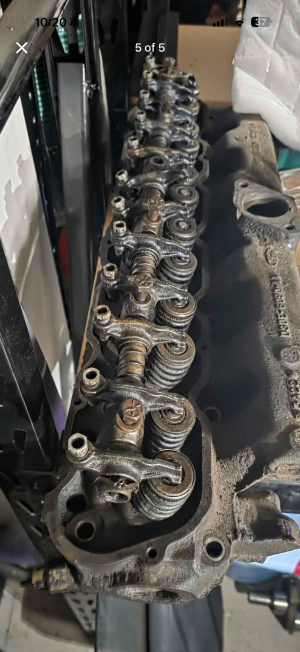
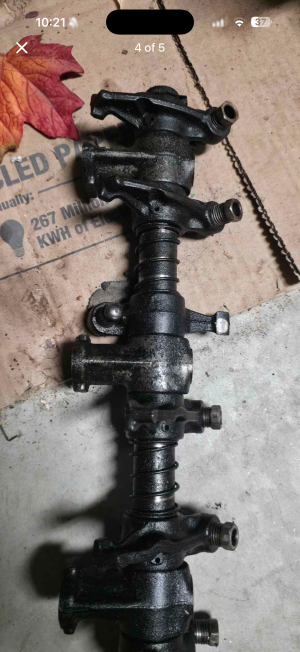
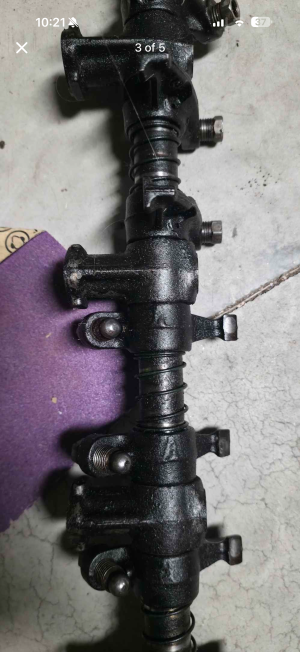

You can buy new adjusters. Which I would recommend, sometimes they turn too easy because of wear causing adjustment problems. Shafts can be replaced too. You just have to watch out for wear on the valve ends. The picture of the one doesn’t look bad but they don’t necessarily wear evenly. I would assume the pads are hardened so just machining them smooth again might not be a good option. If you put them on an occasional driver you would probably be ok, but the more miles you put on it the bigger risk you are taking
WillingnessLimp
Well-known member
Got my compression checked. Dry and wet - same numbers pretty much. The compressor tester I’ve borrowed, doesn’t stay stick to the max for some reason, so numbers are as close as I could catch them. But everything looks pretty solid, as I understand.Ok, the camshaft appears to be good without any lobe failures.
1: 175-180 psi
2: 170-180 psi
3: 175-180 psi
4: 190psi
5: 180 psi
6: 180 psi
Got the rocker arm yesterday and will fire it up again soon without valve cover to make sure that everything is oiling there.

All good, no worries there!Got my compression checked. Dry and wet - same numbers pretty much. The compressor tester I’ve borrowed, doesn’t stay stick to the max for some reason, so numbers are as close as I could catch them. But everything looks pretty solid, as I understand.
1: 175-180 psi
2: 170-180 psi
3: 175-180 psi
4: 190psi
5: 180 psi
6: 180 psi
Got the rocker arm yesterday and will fire it up again soon without valve cover to make sure that everything is oiling there.
frozenrabbit
Famous Member
Factory Ford manual calls for a valve lash of 0.067-0.200". Shoot for 0.13-0.14" , in the middle. That's with factory lifters, maybe a little different with aftermarket.
This is measured between the rocker, and the valve stem tip, WITH the lifter held collapsed.
I think Ford made a tool to hold the lifter collapsed for adjustment, not 100% sure. No tool part number in my manual. I use a close fit size phillips screw driver down in the lifter screw to collapse the lifters.
This is measured between the rocker, and the valve stem tip, WITH the lifter held collapsed.
I think Ford made a tool to hold the lifter collapsed for adjustment, not 100% sure. No tool part number in my manual. I use a close fit size phillips screw driver down in the lifter screw to collapse the lifters.
Last edited:

Does it come with pushrods? The adjustable rockers use a ball and cup pushrod and won't work with the regular ones. I think it might be a good idea to grab that set and rebuild it as necessary. It will give you the ability to dial in the valve lash more effectively than the fixed rocker arms and that might be a good thing since todays head gaskets are much thicker than the ones these engines shipped with. Also, if you do decide to shave the head to bump up compression, you'll need the ability to adjust the valve-lash in the other direction.Side questions, does this adjustable rocker arm looks like worth $100 and shipping (probably about $140 total)
Jmustang_65
Famous Member
Rockerarms unlimited in Redding, CA will rebuild it.Does it come with pushrods? The adjustable rockers use a ball and cup pushrod and won't work with the regular ones. I think it might be a good idea to grab that set and rebuild it as necessary. It will give you the ability to dial in the valve lash more effectively than the fixed rocker arms and that might be a good thing since todays head gaskets are much thicker than the ones these engines shipped with. Also, if you do decide to shave the head to bump up compression, you'll need the ability to adjust the valve-lash in the other direction.
WillingnessLimp
Well-known member
@frozenrabbit so after I put everything back together, hold the lifter side collapsed and check the valve lash?
@awasson no push rods, but they are available on RockAuto…even tho they are pricier than regular ones. I’m waiting on this guy to send me a picture of the large log head he has…might get all together.
@Jmustang_65 thank you! Will reach out to them if I get that arm.
I put everything back and left the valve cover off to see how everything is getting oil. I did leave old push rods for now.
But I can’t start the car - it backfires through the carb. I didn’t change much - just one rocker arm and oil/filter change. Timing was estimated at TDC on compression stroke.
My guess maybe because PCV hose is just hanging there, it gives a lot of vacuum leak and it wouldn’t fire?
Also, I’m still concerned about my carb. I feel like it’s leaking gas a lot. I put new gaskets and they started to soak up gas from the carb. I did put fuel gauge before the carb and it showed 3 psi, which is good for Weber 38/38.
It was a new carb, but maybe I fiddled with it too much and need to completely readjust it (maybe bring somewhere, I feel like I’m starting to fuck things up).
@awasson no push rods, but they are available on RockAuto…even tho they are pricier than regular ones. I’m waiting on this guy to send me a picture of the large log head he has…might get all together.
@Jmustang_65 thank you! Will reach out to them if I get that arm.
I put everything back and left the valve cover off to see how everything is getting oil. I did leave old push rods for now.
But I can’t start the car - it backfires through the carb. I didn’t change much - just one rocker arm and oil/filter change. Timing was estimated at TDC on compression stroke.
My guess maybe because PCV hose is just hanging there, it gives a lot of vacuum leak and it wouldn’t fire?
Also, I’m still concerned about my carb. I feel like it’s leaking gas a lot. I put new gaskets and they started to soak up gas from the carb. I did put fuel gauge before the carb and it showed 3 psi, which is good for Weber 38/38.
It was a new carb, but maybe I fiddled with it too much and need to completely readjust it (maybe bring somewhere, I feel like I’m starting to fuck things up).
Attachments
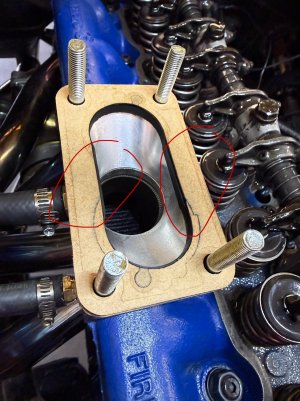
I'm sure you haven't put the carb too far out of spec. They're pretty forgiving and even if you got your idle mixtures all messed up, when you give it throttle, it's off the idle circuit and should be able to run off the mains anywhere from 1200 and up.
I would plug the PCV vacuum line while the valve cover is off.
Did you pull the distributor at any point? Backfiring through the carb can be an indication of a distributor 180° out of orientation.
It's ok for the gaskets to absorb fuel but they shouldn't be leaking at all. Make sure that the base of the carb is true. I can't imagine how it could happen on yours but I have seen old carbs that were torqued down incorrectly and they warped the base.
Just had a thought: The phenolic spacer I have was just ever so slightly out of registration for the mounting holes so it was too tight on the carb studs and I was worried that it would bind or cause a vacuum leak. I drilled all 4 holes out about 1/32" larger than the existing holes and it dropped on perfectly. If yours binds, it is probably the cause of the vacuum leak.
A further thought for later: Are you using manifold vacuum advance or ported off the fitting on the front of the carb. I have come to some conclusions about that recently.
I would plug the PCV vacuum line while the valve cover is off.
Did you pull the distributor at any point? Backfiring through the carb can be an indication of a distributor 180° out of orientation.
It's ok for the gaskets to absorb fuel but they shouldn't be leaking at all. Make sure that the base of the carb is true. I can't imagine how it could happen on yours but I have seen old carbs that were torqued down incorrectly and they warped the base.
Just had a thought: The phenolic spacer I have was just ever so slightly out of registration for the mounting holes so it was too tight on the carb studs and I was worried that it would bind or cause a vacuum leak. I drilled all 4 holes out about 1/32" larger than the existing holes and it dropped on perfectly. If yours binds, it is probably the cause of the vacuum leak.
A further thought for later: Are you using manifold vacuum advance or ported off the fitting on the front of the carb. I have come to some conclusions about that recently.
WillingnessLimp
Well-known member
That was the first thing I did, rotor was pointing at #1 spark plug wire, same spot where I installed itPlease check the distributor orientation.
Bring the crank to TDC on the compression stroke and pull the distributor cap and look at the rotor position.
WillingnessLimp
Well-known member
I'm sure you haven't put the carb too far out of spec. They're pretty forgiving and even if you got your idle mixtures all messed up, when you give it throttle, it's off the idle circuit and should be able to run off the mains anywhere from 1200 and up.
I would plug the PCV vacuum line while the valve cover is off.
Did you pull the distributor at any point? Backfiring through the carb can be an indication of a distributor 180° out of orientation.
It's ok for the gaskets to absorb fuel but they shouldn't be leaking at all. Make sure that the base of the carb is true. I can't imagine how it could happen on yours but I have seen old carbs that were torqued down incorrectly and they warped the base.
Just had a thought: The phenolic spacer I have was just ever so slightly out of registration for the mounting holes so it was too tight on the carb studs and I was worried that it would bind or cause a vacuum leak. I drilled all 4 holes out about 1/32" larger than the existing holes and it dropped on perfectly. If yours binds, it is probably the cause of the vacuum leak.
A further thought for later: Are you using manifold vacuum advance or ported off the fitting on the front of the carb. I have come to some conclusions about that recently.
Thanks, I’ll try plugging PCV and double checking distributor and spacer. I’m pretty certain I dropped it the right way…#1 piston is at TDC, drop the dizzy, line up the mark for first spark plug to the rotor.
Will come back to it later this week and reinstall everything…
I was using ported vacuum on the front of the carb. But when I was starting it now, vacuum line was disconnected and plugged at the carb.
WillingnessLimp
Well-known member
Yes, I’ve checked compression 3-4 days ago. Ignition was disconnected.And compression is good on all cylinders meaning no valves are being held open?
I will remove the dizzy and reinstall it, just in case
Similar threads
All Small Six
Help ID my Frankenstein!
- Replies
- 23
- Views
- 813
- Replies
- 24
- Views
- 1K

All Small Six
Help.. Flywheel installation issue
- Replies
- 20
- Views
- 842
All Small Six
250 Engine Build
- Replies
- 41
- Views
- 2K