I think the guy in the video said he used 50* a lot. But not on a six
I think he was talking about his seat angle preference when he said 50°. I think ours will be 45° seat angle. He seems to work on really exotic high performance stuff.

I think the guy in the video said he used 50* a lot. But not on a six


File and emery cloth was used.@Engine Fan : What tool did you for the backcut and the radius besides the drill press? File or stone?
Also here is an article from Joe Mondello who also talks about backcut and breaking the edge of the intake valves:
"Reface valves 45 º undercut 30 º the same width of your 45 º primary seat angle. On the upper edge of the 45 º next to the margin set your valve re-facer to 50 º and break the edge .005” to .007” wide."
realoldspower.com-Great article by Joe Mondello
Lots of great info in this article written by Joe, plenty of his "hardcore" racing specs. Rocketing the 455 Oldsmobile Engine into the Future By Joe Mwww.tapatalk.com
break the edge of the margin next to the seat, but leave the combustion chamber side of the margin sharp
Did mine for a 300 on the drill press. Lapped the seats after(gray line). Has always been part of a build for me.
No need to backcut the exhaust(one way flow)
Just radius the margin on the exhaust
Keep the intake margin sharp.
FI would fix that problem.

I'm not ready to commit to FI for my Mustang, but I'm beginning a total rebuild on my '35 Chevy. I'm giving it serious consideration since I'm rewiring everything with a Painless kit and will probably replace or rebuild the 350 in it.That’s a very good point. I’m sure it wouldn’t outgrow a 2V Sniper.
I'm not ready to commit to FI for my Mustang, but I'm beginning a total rebuild on my '35 Chevy. I'm giving it serious consideration since I'm rewiring everything with a Painless kit and will probably replace or rebuild the 350 in it.
I prefer doing things in small bites. However, the projects that I buy are nested cans of worms. The wiring on the street rod was horrible, and the gauges didn't work. When I'm doing wiring, I have to pull up the interior, so I might as well clean and paint the inside and put in a new interior while I'm in there. Might as well put in a new firewall and do the engine bay before I weld on the firewall and destroy the new interior, etc. etc. I don't like blowing entire cars apart, but I don't see a better way sometimes. Same with the Mustang and cowl replacement. Might as well get all the welding done at once so I'm not sending sparks over new paint, etc.At this stage in my hot rod building evolution, I’m doing bite-sized, incremental changes to the car so I can keep it on the road during Spring, Summer and any nice days in the Fall. I think for this year coming up, I’ll put the upgraded head on with the Weber 38/38 and cold air intake and heat shields. Then if I feel like it’s got more in it that isn’t being used, I’ll look for FI. I think the head is going to be a pretty major improvement over the stock small log anyway. Good to know there is a bolt in option if I need it.
I think you got it backwards. A 2bl rated at 500cfm flows about 390cfm when rated as a 4 bl.I’ve seen claims that a 38/38 will flow 390 CFM but according to a discussion on another engine site, the 390 CFM rating was arrived at using the 4 barrel methodology of 1.5 inches of vacuum whereas if it is rated as a 2v carb using 3 inches of mercury it flows somewhere between 270 CFM - 300CFM. This was supported by a discussion on the Facebook Weber carb group where a rating of just over 300 CFM was reported.
.

I wouldn't over exert about the carb. It's not like they cut off suddenly. An inch or two of WOT intake vacuum at high rpm is some loss, but it's small. The 38/38 is very close to sufficient for max rpm, and excellent sizing and quality for everything else. . Remember, the "4 barrel" method @ 1.5" means your Weber flows 270-300@ 1.5" vacuum. At 3" it would be 390 cfm. For performance we don't like to see the vac gauge lifting off the seat as max rpm power is approached. But if I have a carb I like, I live with 1-2" vacuum at the redline to prevent compromise everywhere else. . . Just one perspective. .So… I’m thinking about the carburetion for my engine after I get it breathing better.
I was planning on sticking with the 38/38 because it seems to be so dependable and snappy but I wonder if I’m potentially leaving HP on the table.
I’ve seen claims that a 38/38 will flow 390 CFM but according to a discussion on another engine site, the 390 CFM rating was arrived at using the 4 barrel methodology of 1.5 inches of vacuum whereas if it is rated as a 2v carb using 3 inches of mercury it flows somewhere between 270 CFM - 300CFM. This was supported by a discussion on the Facebook Weber carb group where a rating of just over 300 CFM was reported.
When calculating for CFM = (Displacement * Max-RPM * Efficiency) / 3456, I am not sure what efficiency my engine should rate at with the improvements. I’ll be porting the head just to remove obstructions and blend in the guides and I’ll be cleaning up the passages. I’ll also install the port divider on 3 & 4 and gasket match the exhaust outlets and of course I’ll have 1.75” (back cut) intakes and 1-15/32” exhausts. I’m aiming for a 9.5:1 taking into account a felpro head gasket, piston height, etc. I might be able to get slightly more than that but I won’t know until I CC the head after all of the other work is done.
If I’m being conservative and use 85% with the 60 over 206ci and 5500 RPM per Clay Smith’s camshaft specs, I get 279 CFM @ 5500 RPM, which should be on par with the 38/38 but If I consider my VE being a little hotter at 95% with 9.5:1 compression, ported head, bigger back cut valves, etc…, then it comes out to 311 CFM @ 5500 RPM and the 38/38 will not deliver.
I guess I’ll cross that river when I come to it but it makes me wonder if I should plan for a bigger carb.
I think you got it backwards. A 2bl rated at 500cfm flows about 390cfm when rated as a 4 bl.
IE more suck = more cfm
I wouldn't over exert about the carb. It's not like they cut off suddenly. An inch or two of WOT intake vacuum at high rpm is some loss, but it's small. The 38/38 is very close to sufficient for max rpm, and excellent sizing and quality for everything else. . Remember, the "4 barrel" method @ 1.5" means your Weber flows 270-300@ 1.5" vacuum. At 3" it would be 390 cfm. For performance we don't like to see the vac gauge lifting off the seat as max rpm power is approached. But if I have a carb I like, I live with 1-2" vacuum at the redline to prevent compromise everywhere else. . . Just one perspective. .


85% would be the absolute best you could expect, (even thats probably high) and that will be at peak torque, not peak power, which is more likely to be around 60%.So… I’m thinking about the carburetion for my engine after I get it breathing better.
I was planning on sticking with the 38/38 because it seems to be so dependable and snappy but I wonder if I’m potentially leaving HP on the table.
I’ve seen claims that a 38/38 will flow 390 CFM but according to a discussion on another engine site, the 390 CFM rating was arrived at using the 4 barrel methodology of 1.5 inches of vacuum whereas if it is rated as a 2v carb using 3 inches of mercury it flows somewhere between 270 CFM - 300CFM. This was supported by a discussion on the Facebook Weber carb group where a rating of just over 300 CFM was reported.
When calculating for CFM = (Displacement * Max-RPM * Efficiency) / 3456, I am not sure what efficiency my engine should rate at with the improvements. I’ll be porting the head just to remove obstructions and blend in the guides and I’ll be cleaning up the passages. I’ll also install the port divider on 3 & 4 and gasket match the exhaust outlets and of course I’ll have 1.75” (back cut) intakes and 1-15/32” exhausts. I’m aiming for a 9.5:1 taking into account a felpro head gasket, piston height, etc. I might be able to get slightly more than that but I won’t know until I CC the head after all of the other work is done.
If I’m being conservative and use 85% with the 60 over 206ci and 5500 RPM per Clay Smith’s camshaft specs, I get 279 CFM @ 5500 RPM, which should be on par with the 38/38 but If I consider my VE being a little hotter at 95% with 9.5:1 compression, ported head, bigger back cut valves, etc…, then it comes out to 311 CFM @ 5500 RPM and the 38/38 will not deliver.
I guess I’ll cross that river when I come to it but it makes me wonder if I should plan for a bigger carb.
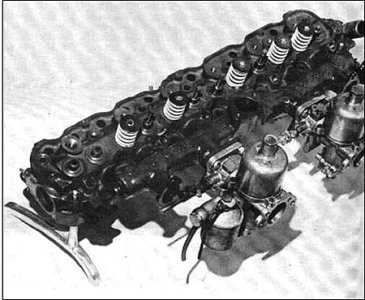
Missed the multi-carb discussion last month. Some pixxors, food for thought.
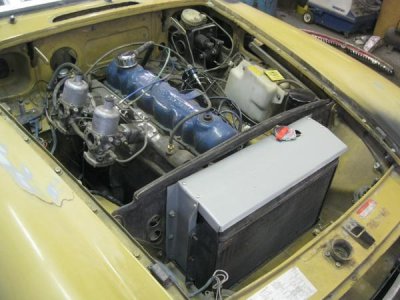
SU Carb assemblies and constituent parts are currently produced new by Burlen in the UK. If you want new carbs, bend over, they're pretty pricy, but but less eye-watering pieces can be obtained by purchasing used carbs. I have an MGC (six cylinder MG) that came stock with qty=2 HS-6 SU's (1.75 throttle bore size) and have a triple intake manifold. Scour e-bay for MG, Triumph, and Volvo for the carbs and have them sent in to a reliable rebuilder. There are a couple of quality rebuilders in the US (Joe Curto on the east coast, Jimmy Hilton in TX are my favs) The can be set up from straight horizontal to about 45 degree downdraft. I've seen one example of a true down draft.
Do not confuse SU's with Zenith Strombergs- SU's are a less complex carb and more highly tunable
Edit- the B&W picture is using a more primitive variant an HD-6- The 200 in an MG is using a latter variant- HIF-4 (1.5" throttle bore
I should point out these are constant depression carbs- the have both a throttle plate and a vacuum controlled piston.
I have often thought two 32/36 mounted like you describe would work really well. It could very well overcome much of the limitation of the log design. And you would get to enjoy the experience of flooring it and feeling the secondary's kick in! A flat top log head will fit a 2100 with machining and adapter mounted and the 32/36 is likely smaller base dimensions. The air cleaner would require some planning.Well... I have the head, the valves, springs (thanks @DON ), adjustable rockers, pushrods and rebuilt shaft (thanks @TrickSix ). Now I'm thinking about the carburetor(s) again.
I have been looking at the large log and thinking about how best to distribute the fuel to the 6 intakes. I'm looking at that MG with the SU's and it looks to me like having a pair of carbs like that or two down drafts situated between #2 and #3 and #4 and #5 is the best option keeping in mind that I have to work with the design of that log intake.
I'm not opposed to putting side drafts on but I have been really happy with Weber down drafts when I've had them. Has anyone blocked off the stock opening and machined the large log for a pair of down drafts between #2 and #3 and #4 and #5? That seems to me to be the best distribution and with a pair of 32/36's or a pair of 38/38's it should have as much carburetion that head can flow without cutting the log right off.